
Govern AI Development Across the Whole Org
As AI agents scale from a few developers to the entire organization, per-PR review stops working. AppGenie gives every agent one structured product model to build against and tests that verify the output against the spec — the foundation for governing AI development at scale.
Join the Enterprise Preview →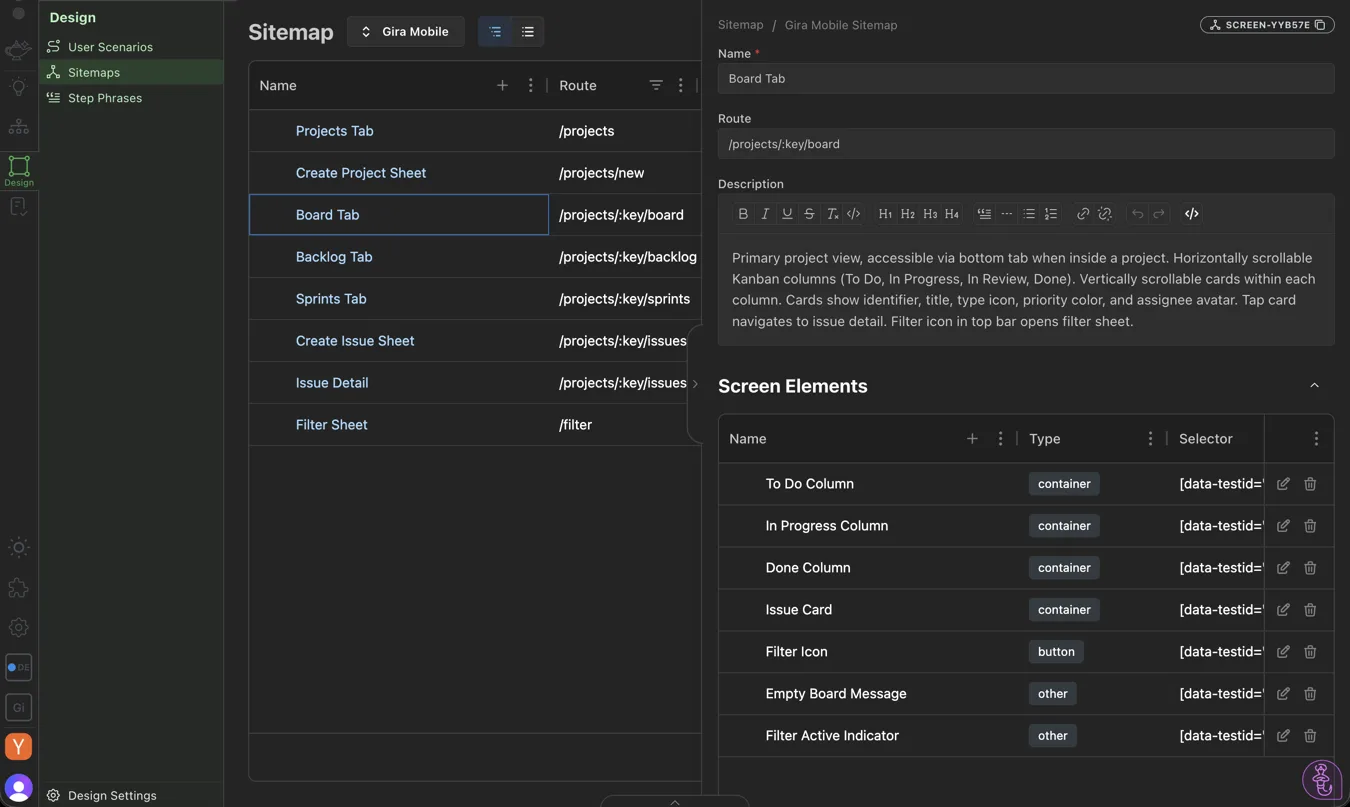

Velocity Scales. So Does the Risk.
AI agents generate code without your business logic, compliance constraints, or architecture in view. When adoption goes org-wide, individual code review can't hold the line — you need governance that's structured, not manual.

Individual Review Stops Scaling
A few developers using AI agents is a workflow change. The whole organization using them is a governance problem. Per-PR human review can't cover output generated faster than people can read it — and the gaps don't announce themselves.

No Trail from Intent to Code
When an audit asks how you verify AI-generated code quality, "we do code review" isn't an answer. Without a structured link from specification to implementation, there's no traceability for SOC 2, regulated data, or financial workflows.

Architectural Drift Across Agents
Agents working in different services implement overlapping features with inconsistent behavior. Without a shared contract, each repo drifts on its own — and the drift surfaces in production, not in review.

Infrastructure observability tells you the agent ran. The question a CTO has to answer is whether it built the right thing — against a specification, with a trail to prove it.
One Product Model,
Every Agent
Architectural drift happens when agents in different repos work from different context. AppGenie's product model is the single structured representation of the whole product — features, scenarios, acceptance criteria, and their relationships. Every agent, regardless of which service or tool, reads from the same contract. That's how you keep behavior consistent across an org that ships with many agents at once.
See AI product development →
Verify the Build,
Not Just the Diff
Tests generated from your product scenarios run in the CI/CD you already operate, mapping every failure back to the requirement it verifies. Code review keeps doing what only humans can — architecture and judgment — while specification conformance is checked automatically. That's quality that scales with agent usage instead of with headcount.
Explore AI E2E testing →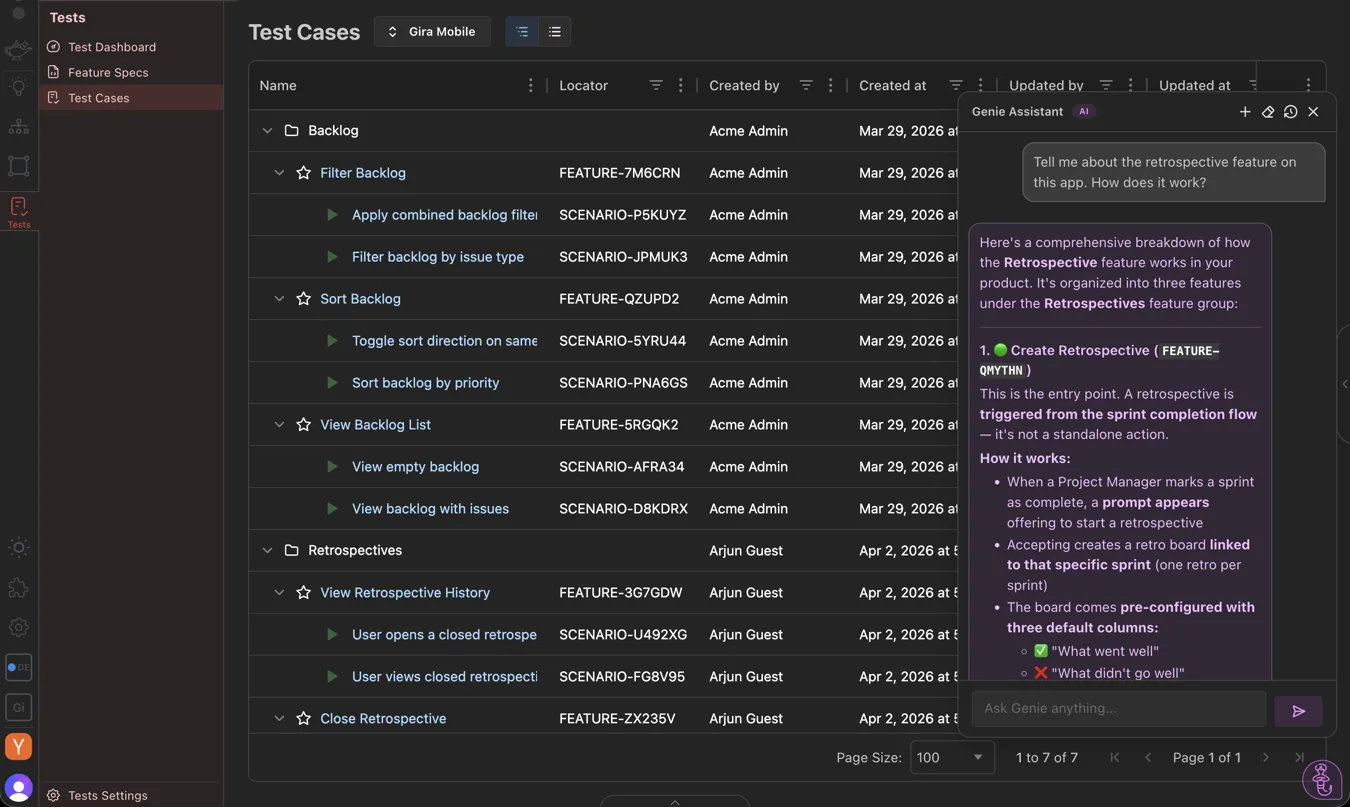

Key Features
One model every agent reads, with automated spec verification — and an org-scale governance layer: dashboard, review queue, audit logs, and CI checks.
- ✓ One structured product model every agent reads (MCP read + write)
- ✓ Tests generated from specs verify agent output
- ✓ Standard Playwright — runs in your existing CI/CD
- ✓ Tool-agnostic: Claude Code, Cursor, any MCP agent, one contract
- ◇ Agent activity dashboard — work mapped to features Coming Soon
- ◇ Product-aware human review queue for high-risk changes Coming Soon
- ◇ Audit logs: full chain from specification to implementation Coming Soon
- ◇ Intent-conformance CI checks before merge Coming Soon

The Governance Loop
Read, verify, gate, audit — anchored to product intent, not diff size. The first two steps are live; the last two are the roadmap.
Agents Read the Model
Every agent, in every service, pulls structured product context from one source — the shared contract.
Tests Verify Output
Tests generated from scenarios run in your CI/CD and confirm the build matches the spec.
Gates Catch Deviation
Coming soon: product-aware review gates escalate high-risk or drifting changes before merge.
Audit the Chain
Coming soon: a full trail from specification to implementation, ready for compliance review.

A Different Layer Than Observability
Token-and-latency platforms watch the model. AppGenie watches whether the product got built the way you specified it — and is building toward the trail that proves it.
| Concern | LLM observability | AppGenie |
|---|---|---|
| Agents share one product contract | No | Yes — MCP read + write |
| Output verified against the spec | No | Yes — tests from scenarios |
| Tool-agnostic governance layer | Per-integration | Yes — at the model level |
| Audit trail intent → implementation | No | Coming soon |
| Review gates on product sensitivity | No | Coming soon |
| Activity mapped to product features | No | Coming soon |

Frequently Asked Questions
What CTO tools exist for AI agent governance?
Most focus on infrastructure observability — token usage, cost, model performance. AppGenie operates at the product-intent layer. Today, agents read one structured product model and tests verify their output against it. Audit trails, review gates that fire on product sensitivity, and an activity dashboard are on the roadmap — see AI agent management.
How does AppGenie integrate with enterprise CI/CD pipelines?
AppGenie generates standard Playwright tests that integrate into your existing pipeline — GitHub Actions, GitLab CI, Jenkins, whatever you run. No proprietary runner, no vendor lock-in. Your pipeline runs the tests; AppGenie provides the specification-to-test generation layer.
Can AppGenie govern multiple AI coding agents at once?
Yes. AppGenie operates through the product model, not through per-agent integrations. Any MCP-compatible agent — Claude Code, Cursor, Windsurf — reads from the same structured model, so teams keep their preferred tools while sharing one source of product intent. Org-wide governance policies on top of that are on the roadmap.
How is AppGenie different from LLM observability platforms?
LLM observability tells you the agent ran correctly — tokens, latency, error rates. AppGenie addresses whether the agent built correctly — whether output matches the specification. The verification layer is live today; the monitoring and review layers are on the roadmap. Both are valuable; they sit at different layers.
What does enterprise deployment look like?
Team and enterprise plans add team-wide product models and centralized access — see pricing for tiers. Governance reporting and centralized policy enforcement are on the roadmap. The fastest way to scope a rollout is a conversation: talk to us.
Scaling AI agents across your org?
We're onboarding a small group of design partners before launch. Add your company and we'll reach out about early access for your team.
Join the Enterprise Preview →