
Product Development Software for AI-Native Teams
Five tools, each owning a fragment of the truth, held together by copy-paste. AppGenie replaces the disconnected toolchain with one product model — defined once and read by every role, every test, and every AI agent.
Join the Waitlist →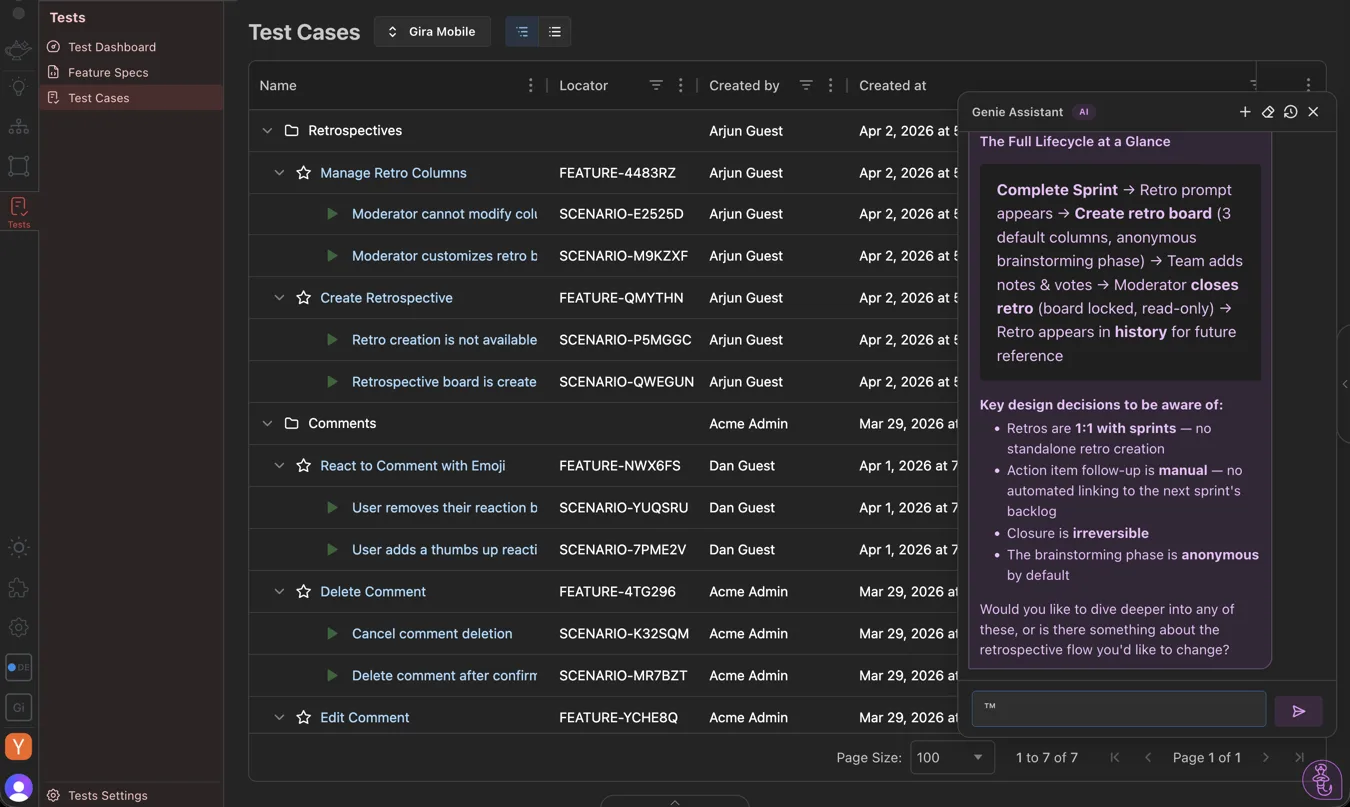

Software Product Development Runs on Five Disconnected Tools
A PM tool, a tracker, a design tool, a repo, a test framework. Each owns a fragment of the product truth; none owns the whole picture. Teams lose a substantial share of their time translating context between them — and every translation introduces drift.

Intent Lost in Translation
The PM's vision lives in a PRD. A developer turns it into tickets. A designer reads it as wireframes. An agent gets a prompt derived from the ticket. At every step, context is lost and assumptions creep in — until the spec is "documented" but connected to nothing that reads it.

AI Multiplies the Fragmentation
When an agent can generate a feature in minutes, the loop between "what was specified" and "what was built" has to get tighter, not looser. Without structured input, agents fill gaps with assumptions — code that looks correct but misses the spec.

Quality Is a Retroactive Fix
In the disconnected-tools model, quality is checked after the fact — review, QA, user complaints. By the time a spec-vs-implementation gap surfaces, it's expensive. The output passed unit tests; it just didn't do what the product was supposed to do.

Velocity without alignment isn't progress. It's rework — produced faster.
One Product Model,
Not Five Disconnected Tools
Everything starts and ends with the product model — a structured representation of what your product does, how it behaves, and why each feature exists. It isn't a document. It's a connected data structure every other system reads from: features connect to scenarios, scenarios to acceptance criteria, criteria to generated tests, tests to agent output. The chain is traceable from intent to behavior with no manual translation.
What is a product model? →
Built for AI Agents,
Not Bolted On
AI agents perform in direct proportion to the context they receive. A vague ticket produces vague code; a structured spec — defined scenarios, acceptance criteria, connected test expectations — produces implementation that matches intent. AppGenie exposes the product model to Claude Code, Cursor, and any MCP-compatible agent, which read and write it directly. Fewer hallucinated behaviors, fewer missed edge cases, less post-generation rework.
Explore integrations →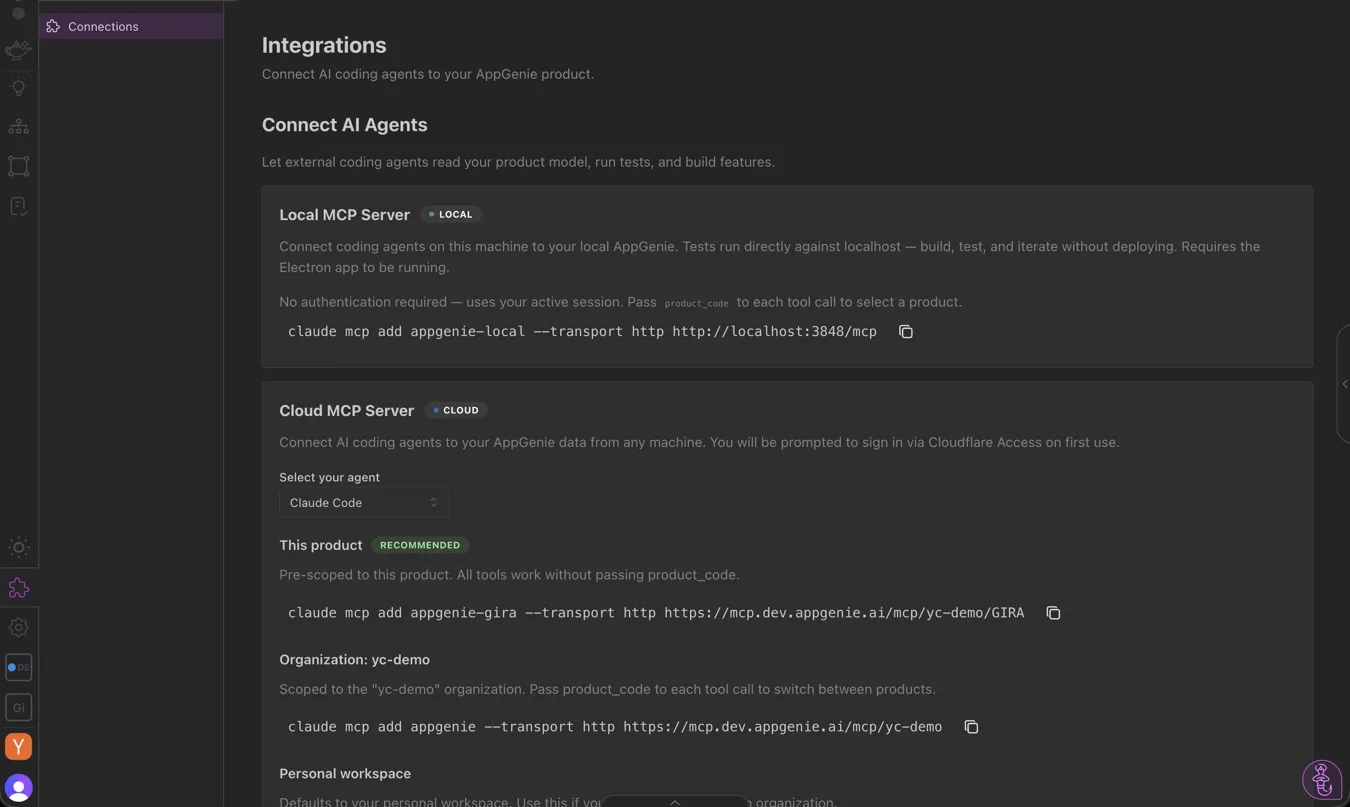

From Intent to Implementation
Spec-driven development as a platform, not a folder of markdown files. Define, Build, and Test are live today. Govern is the roadmap horizon — and we say so plainly.
Define
Capture and prioritize ideas, promote them to features, and write Given/When/Then scenarios with acceptance criteria. Shipped.
Build
Agents read the product model via MCP and generate implementation aligned to the spec — structured context, not prompt guesswork. Shipped.
Test
E2E tests generate from feature scenarios and verify product intent automatically, with an AI healing loop. Shipped.
Govern
Monitor agent output against the spec; deviations trigger review. Spec-alignment governance is on the roadmap.

Key Features
The product model, structured specs, test generation, and MCP read/write — with governance, intent checks, roadmaps, and project-tracker sync.
- ✓ One product model — features, scenarios, acceptance criteria, roles
- ✓ Given/When/Then specs with reusable step phrases
- ✓ E2E test generation from scenarios, with AI healing
- ✓ MCP integration — agents read and write the model
- ✓ Idea capture + RICE prioritization
- ✓ Every role reads the same model (no translation steps)
- ◇ Spec-alignment governance & CI-native intent checks Coming Soon
- ◇ Roadmaps, sprint planning, Jira / Linear sync Coming Soon

Who Builds With AppGenie
The model earns its keep the moment more than one mind — human or agent — has to stay aligned on what the product should do.

Startups
Ship faster without piling up AI-generated debt. When you're small enough to hold context in your heads, the model feels like overhead — until your second agent or third developer, where it pays for itself in a week. Free tier available.

Growth-Stage Teams
Scale AI adoption across many developers and agents without losing alignment. Growth teams hit a coordination ceiling when AI-generated code creates conflicting implementations; one shared source of truth prevents it.

Enterprise
Build toward structured AI governance across the org — a traceability chain from requirement to implementation to test result. The model and tests are live today; the governance and audit-trail layer is on the roadmap.

Frequently Asked Questions
What is product development software?
Product development software supports creating, building, and delivering a product. For software teams that has historically meant a stack of disconnected tools — requirements, project tracking, design, code, and testing — each owning a fragment of the truth. AppGenie unifies the specification layer into a single product model that drives the lifecycle: AI-agent context, test generation, and (on the roadmap) governance.
What is AI-native product development?
AI-native product development treats AI agents as first-class participants in building software — not just coding assistants, but agents that read structured specifications and generate aligned implementations. AppGenie makes this possible through spec-driven development: the product model gives agents the structured context they need, via MCP, so output matches intent.
How is AppGenie different from Jira or Linear?
Jira and Linear are project trackers — they manage tasks and workflows. AppGenie manages product intent — the structured specification of what the product does and how it behaves. They coexist: AppGenie owns the specification layer; the tracker owns the workflow layer. Bidirectional sync is on our roadmap.
Do I need to replace my existing tools?
No. AppGenie complements your stack, it doesn't replace it. Your team keeps its IDE, repository, CI/CD pipeline, and communication tools. AppGenie adds the specification layer that sits above them — the product model your agents and tests consume.