
Cursor, With Your Product Model in Context
Cursor is a powerful AI code editor. AppGenie makes it precise. Connect via MCP and every session — Composer, Chat, inline edits — starts with structured features, scenarios, and acceptance criteria read straight from your product model.
Join the Waitlist →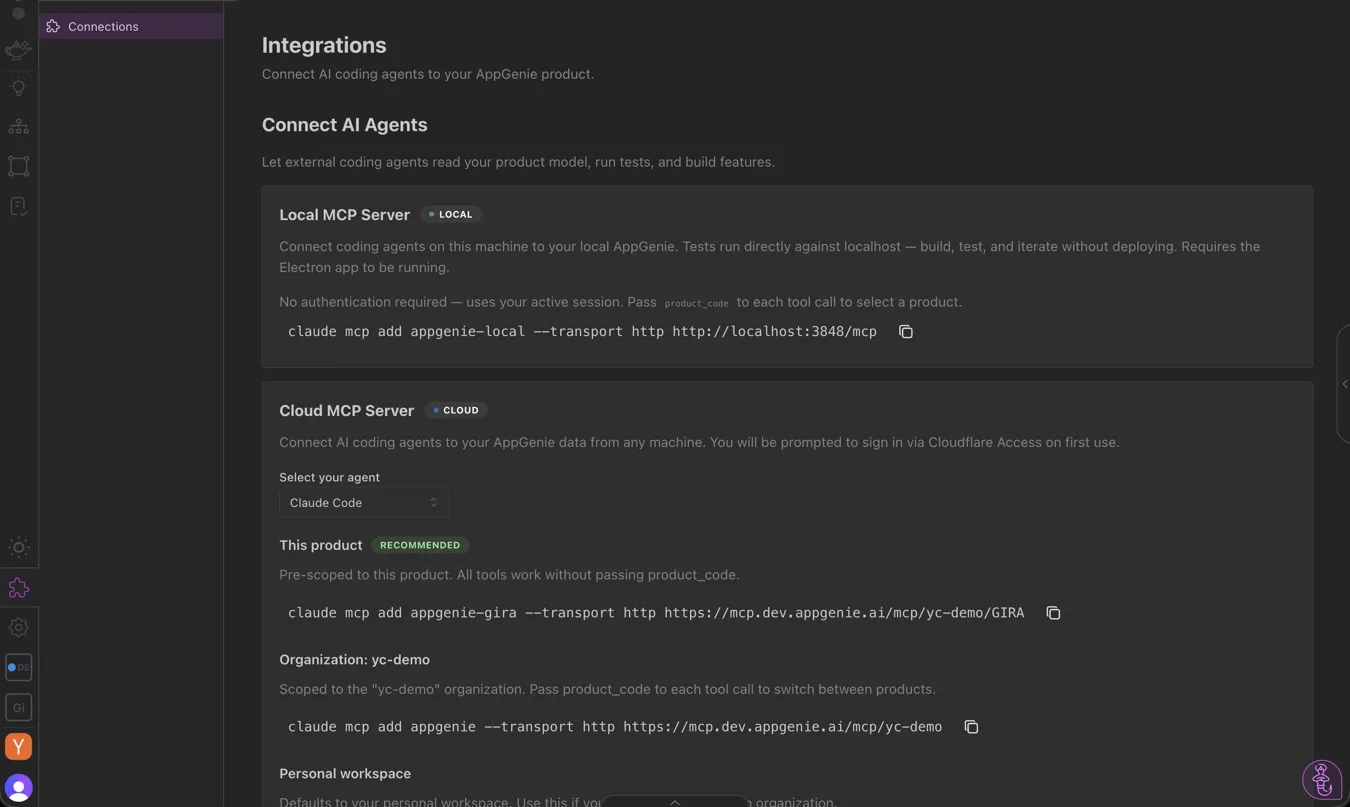

What Cursor Gets From AppGenie
Structured, queryable product context delivered to every agent surface — not inferred from whatever file happens to be open.

Context in Every Surface
Composer, Chat, and inline edits all start from the same structured product context — features, scenarios, and acceptance criteria read from your model, not inferred from the open file.
Bidirectional Read + Write
Cursor reads the product model and writes back to it — scaffolding features, scenarios, tasks, elements, and ideas as implementation surfaces new requirements. The agent contributes to the model.

Tests That Verify Intent
AppGenie generates E2E tests from the same scenarios Cursor built against. Run them against the output to confirm it satisfies the spec — not just that it compiles.

An agent working from the open file guesses your requirements. An agent working from the product model knows them — across every session, not just the one with the right tab open.
One Spec,
Every Session
Cursor sessions are only as consistent as the context they start from. Connected to AppGenie, every Composer run, Chat, and inline edit reads the same structured feature — its scenarios and acceptance criteria — before generating code. And the integration is bidirectional: as implementation reveals new requirements, Cursor writes them back into the model so the next session starts from the updated spec.
What is a product model? →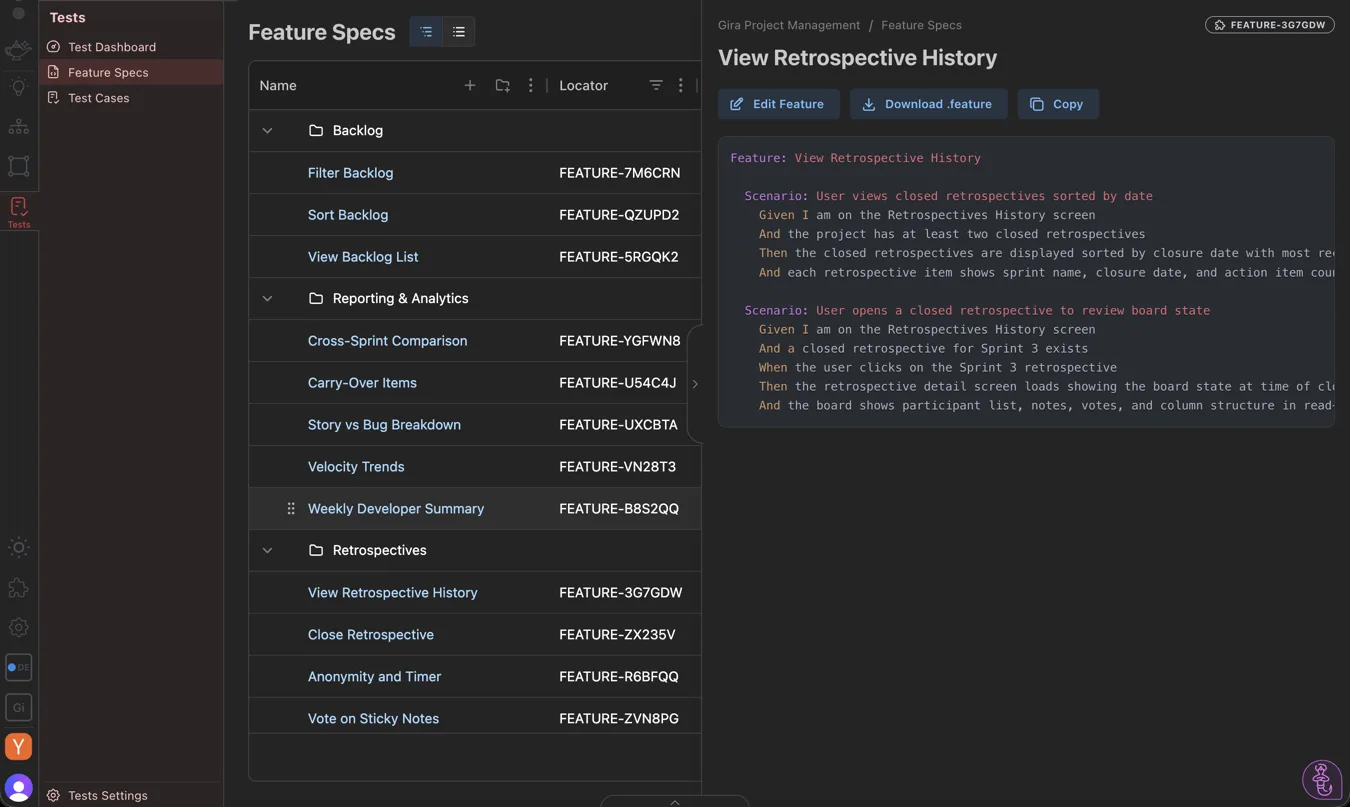

How to Set It Up
Your configuration lives in the app, ready to copy into Cursor — no prompt-engineering workarounds, no pasted requirements.
Build Your Product Model
Define features and scenarios with acceptance criteria — the structured spec Cursor will read.
Get Your Config In-App
Open the Integrations page in the AppGenie app for your MCP server configuration and API key, with copy-ready Cursor setup instructions.
Every Session Has Context
Composer, Chat, and inline edits read the relevant feature and its scenarios from AppGenie before generating or modifying code.
Verify With Generated Tests
Run the E2E tests AppGenie generated from those scenarios against the result. The tests check product intent, not just compilation.

What Changes in Your Workflow
Same editor, same agent. The difference is everything it knows before it starts.
| A Cursor Composer session | Without AppGenie | With AppGenie |
|---|---|---|
| Context the agent starts from | Open files + recent chat | Feature spec + scenarios + criteria |
| Edge cases handled | Whatever it infers | The ones you defined |
| Consistency across sessions | Varies with what's open | Same model every time |
| Alignment to your intent | Approximate | Anchored to the spec |
| Verification | Does it compile? | Does it satisfy the scenarios? |

What's Live Today
The MCP read + write integration is shipped. Setup runs through the in-app Integrations page today; a published one-line install package is on the way.
- ✓ Read features, scenarios, and acceptance criteria via MCP
- ✓ Works across Composer, Chat, and inline edits
- ✓ Write back: create/update features, scenarios, tasks, steps, ideas
- ✓ Cross-feature awareness from the product-model graph
- ✓ E2E tests generated from the same scenarios for verification
- ◇ Published npm/npx package for one-line install Coming Soon

Frequently Asked Questions
How do I connect Cursor to AppGenie via MCP?
Build your product model in AppGenie, then open the Integrations page inside the app for your MCP server configuration and API key — with copy-ready Cursor setup instructions. Once connected, every session starts with your structured product context.
Does it work across Composer, Chat, and inline edits?
Yes. Because context is delivered through MCP, any Cursor surface that uses the agent — Composer, Chat, or inline edits — reads your features, scenarios, and acceptance criteria from the product model before generating or modifying code.
Is the AppGenie MCP integration bidirectional?
Yes. Cursor can read the product model and write back to it — creating or updating features, scenarios, tasks, steps, elements, screens, roles, and ideas as implementation reveals new requirements.
Does this work with spec-driven testing?
Yes. AppGenie generates E2E tests from the same feature scenarios Cursor builds against, so you can verify the generated code satisfies product intent — not just that it compiles.
Give every Cursor session the spec.
Join the waitlist to connect Cursor via MCP at launch.
Join the Waitlist →