
AI for Product Managers Who Ship, Not Just Plan
Stop re-typing the same intent into PRDs, tickets, and agent prompts. AppGenie turns your requirements into a living product model that generates tests and feeds the AI agents writing your code — from one structured source of truth.
Join the Waitlist →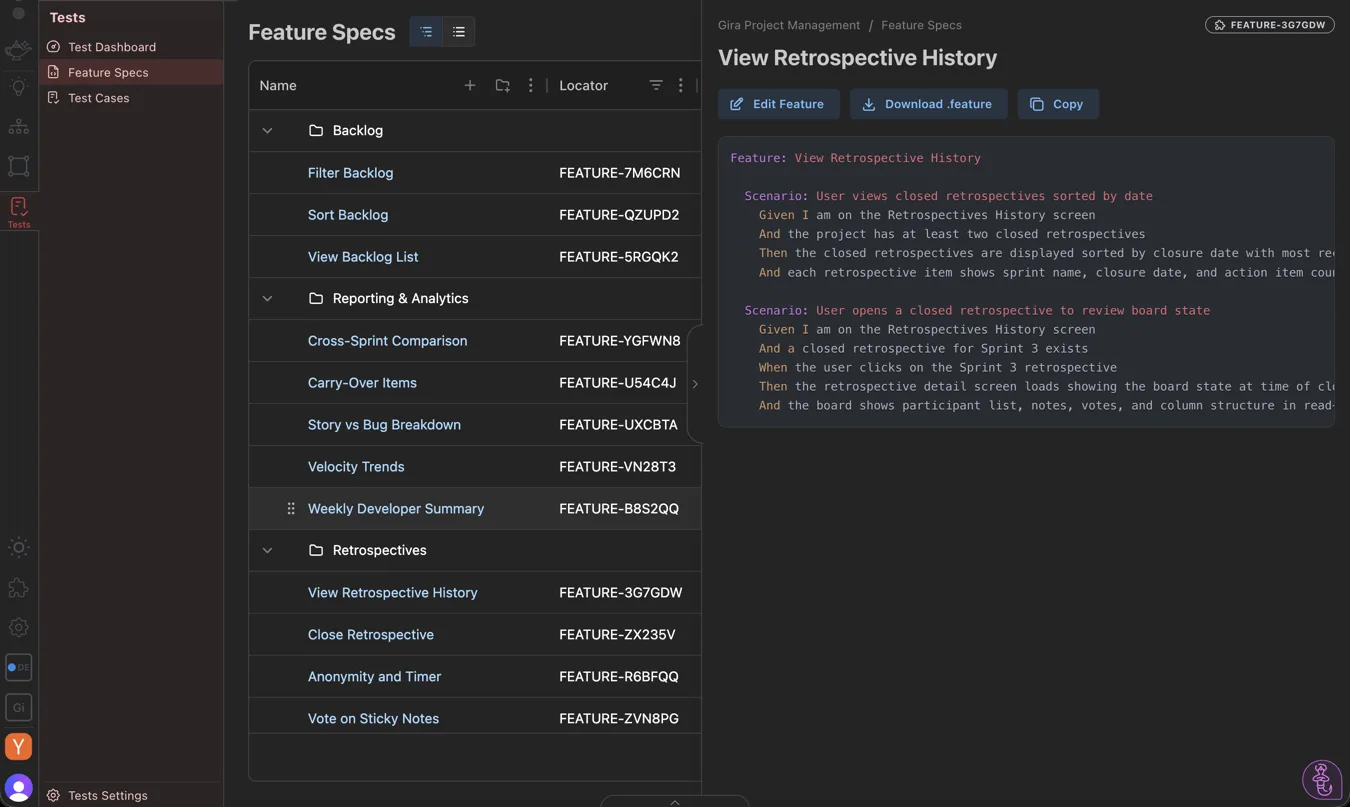

Most of the Job Is Keeping Intent in Sync
PRDs that get skimmed, tickets that lose context, prompts written from memory. The PM's real work isn't writing the spec — it's stopping the spec from drifting across five tools that don't talk to each other.

The Alignment Tax
You write the PRD, then re-type it as tickets, then re-explain it in standup, then paste it into an agent prompt. Every translation drops detail. Most of a PM's week goes to keeping the same intent in sync across tools that don't share a source of truth.

Specs Agents Can't Read
AI coding agents don't attend your sprint planning or read between the lines of a Google Doc. When an agent in Claude Code or Cursor builds a feature, it builds exactly what it was handed. A paragraph in Notion is not a specification an agent can execute.

Prioritization by Volume
The loudest stakeholder wins the roadmap meeting and the data is nowhere in the room. Without a consistent scoring model, prioritization stays political — and the features that ship are the ones with the best advocate, not the best case.

The PRD was written for a human who reads every word. AI agents don't. They build exactly what the spec says — so the spec has to be something a machine can execute, not just read.
A Product Model,
Not Another PRD
In AppGenie your requirements aren't a document that gets filed — they're a structured product model. Features carry scenarios, scenarios carry acceptance criteria, and every downstream system reads from the same source. One artifact is simultaneously your specification, your test definition, and the context your AI agents build against. No copy-paste, no context loss between intent and code.
What is a product model? →
Make Prioritization
a Data Conversation
AppGenie's Ideas module scores with RICE — Reach, Impact, Confidence, Effort, plus an optional strategic weight — across card, kanban, and table views. Capture ideas, let the team vote, and add your own market-signal data by hand when you have it. Then promote the winners straight into structured features. The scoring is yours to enter; AppGenie keeps it consistent and wired to the features it ranks.
Explore idea management →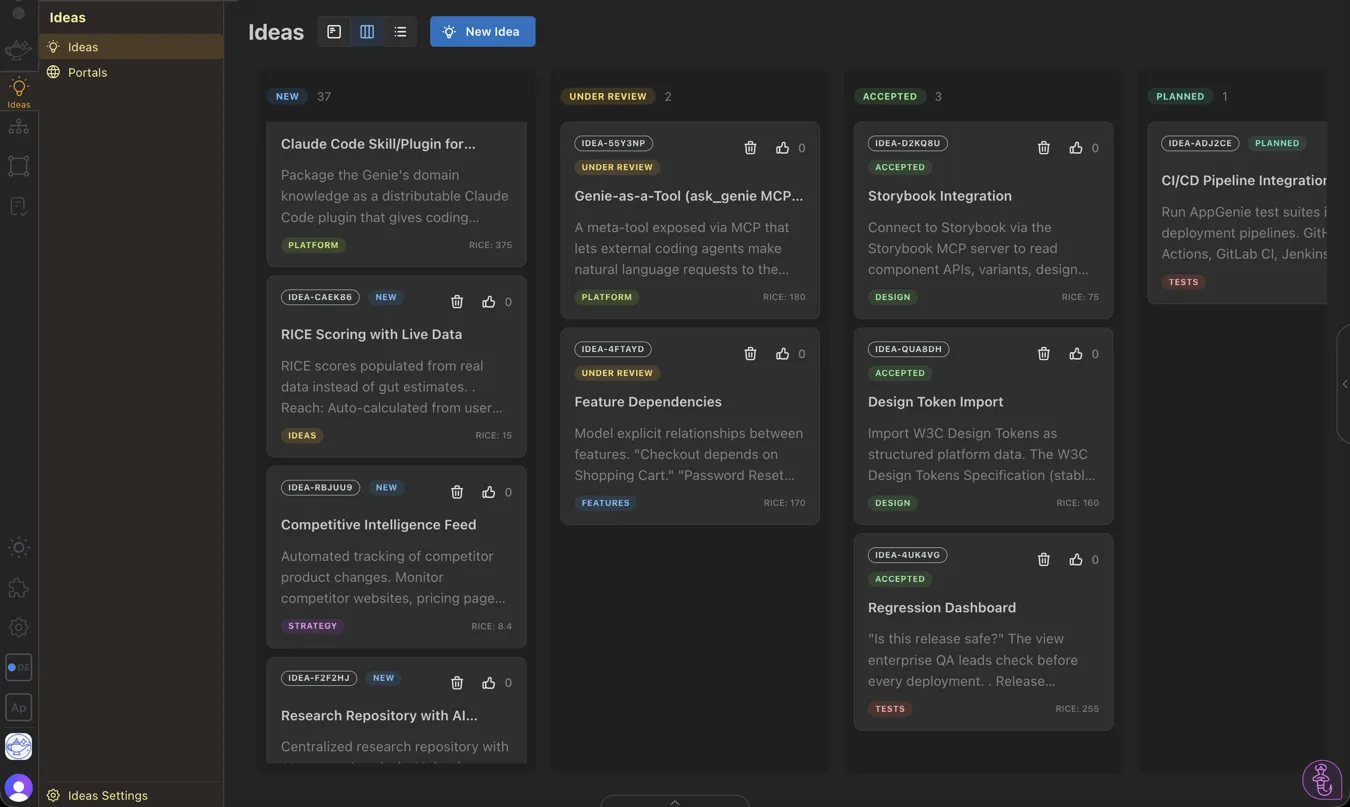

Key Features
The product model, scenarios, test generation, and agent integration — with a dedicated PRD authoring experience, roadmap and sprint views, and project-tracker sync.
- ✓ Living product model — features, scenarios, acceptance criteria
- ✓ Plain-language or Given/When/Then scenarios with reusable steps
- ✓ E2E test generation directly from your scenarios
- ✓ MCP integration — agents read and write the model
- ✓ Ideas with RICE scoring (card, kanban, table views)
- ✓ Promote an idea straight into a structured feature
- ◇ Dedicated PRD authoring experience Coming Soon
- ◇ Roadmap and sprint planning views Coming Soon
- ◇ Jira / Linear bidirectional sync Coming Soon

From Idea to Tested Software
Your specification stops being a document you maintain and becomes the source of truth that drives the build — and the agents.
Capture & Score
Ideas come in from anywhere, get voted on, and are scored with RICE in one place.
Promote to Features
Turn the winners into structured features with scenarios and acceptance criteria.
Generate Tests
E2E tests generate directly from those scenarios — your spec becomes the check.
Align Agents
Coding agents read the live model through MCP before they write a line of code.

What Changes for You
Same job — define product intent and make it real — with the translation tax removed.
| The PM's work | Without AppGenie | With AppGenie |
|---|---|---|
| Where the spec lives | PRD doc, separate from build | A structured product model |
| How agents get context | Hand-written prompts per task | Agents read the model via MCP |
| What verifies the build | A separate test plan, later | Tests generated from scenarios |
| How features are ranked | Whoever argues hardest | RICE scoring across views |
| When intent drifts | Found in review, or in prod | A failing test points to the spec |

Frequently Asked Questions
What AI tools do product managers need?
Product managers benefit most from AI tools that connect their specifications to development execution — not standalone writing assistants or chatbots. The highest-leverage tools (1) structure requirements as testable scenarios, (2) provide AI coding agents with product context, and (3) generate automated tests from those scenarios. AppGenie combines all three in one spec-driven platform.
How does AppGenie help product managers?
AppGenie gives you a structured product model that drives everything downstream. Requirements become scenarios, scenarios generate tests, and AI coding agents read the model through MCP. You define intent once instead of re-typing it into tickets, prompts, and test plans.
Can product managers use AppGenie without technical skills?
Yes. Features and scenarios are written in plain language, and the product model is a visual, structured interface — not code. Test generation and AI agent integration happen from the specifications you define. No scripting, query languages, or configuration files.
Does AppGenie pull in market data for prioritization automatically?
No — and we won't pretend otherwise. RICE scoring and any market-signal data are entered by you. AppGenie gives you the structure to make prioritization a consistent, evidence-based conversation; it does not auto-fetch keyword volume or competitive data. You bring the signal; AppGenie keeps it organized and connected to the features it informs.
How is AppGenie different from Jira or Linear for product managers?
Jira and Linear manage who works on what and when. AppGenie manages what the product should do and connects that definition to tests and AI coding agents. The two are complementary — AppGenie is the product-intent layer above your tracker. Bidirectional Jira and Linear sync is on our roadmap.
Define it once. Let it drive everything.
Join the waitlist for early access to the living product model.
Join the Waitlist →