
Idea Management That Builds What It Captures
Most idea tools are suggestion boxes: collect, vote, and then nothing. AppGenie's Ideas module is the front of a pipeline — capture with context, prioritize with RICE, then promote straight into a structured feature your agents and tests build from.
Join the Waitlist →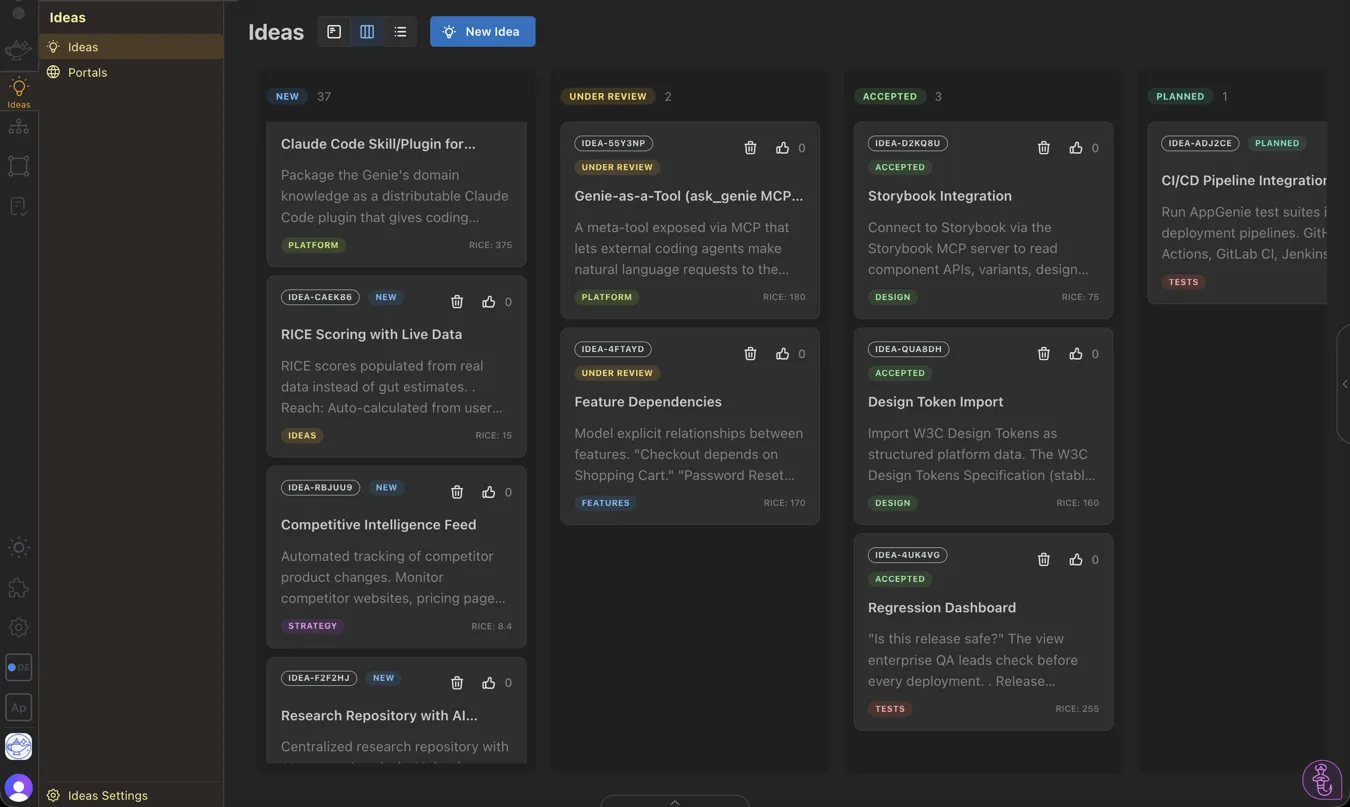

Most Idea Management Is Where Ideas Go to Die
Capture, vote, and then — nothing. The idea sits in one tool while the roadmap, the specs, and the tests live in three others. The value was never in collecting ideas. It's in connecting ideation to execution.

The Idea Lives in One Tool
Ideas pile up in a voting portal. The roadmap lives in a different tool. The specs live in a third. Each boundary is a place where context degrades — and the trip from "good idea" to "shipped feature" is paved with meetings and copy-paste.

Context Dies on the Handoff
Someone reads the idea, interprets it, and writes a ticket in another system. By the time a developer reads that summary, two rounds of telephone have degraded the original intent. The discussion, the source, the "why" — gone.

Votes Aren't Priorities
A popularity contest surfaces the loudest request, not the highest-leverage one. Without a structured score, prioritization is whoever argues hardest in the room — and the best ideas lose to the most confident voices.

A good idea and an important idea are not the same thing. Every team has more ideas than capacity — the question is which one to build next, and why.
Ideas That Become Software,
Not Ideas That Vanish
This is where AppGenie diverges from every other idea tool. When an idea is validated and prioritized, it promotes directly into a feature in your product model — the description, discussion, source, and votes carry forward. There's no export, no Jira ticket, no telephone game. The idea becomes the feature. The feature becomes the spec. The spec drives the tests and the agents.
What is a product model? →
Prioritize With Evidence,
Not the Loudest Voice
Score ideas on RICE — Reach, Impact, Confidence, Effort, plus an optional strategic weight — and rank them automatically across card, kanban, and table views. When you have it, attach market-signal data by hand: an idea tagged with 4,000 monthly searches and a $12 CPC is evidence of demand, not a guess. Prioritization stops being a debate and becomes a number you can defend.
See the full comparison ↓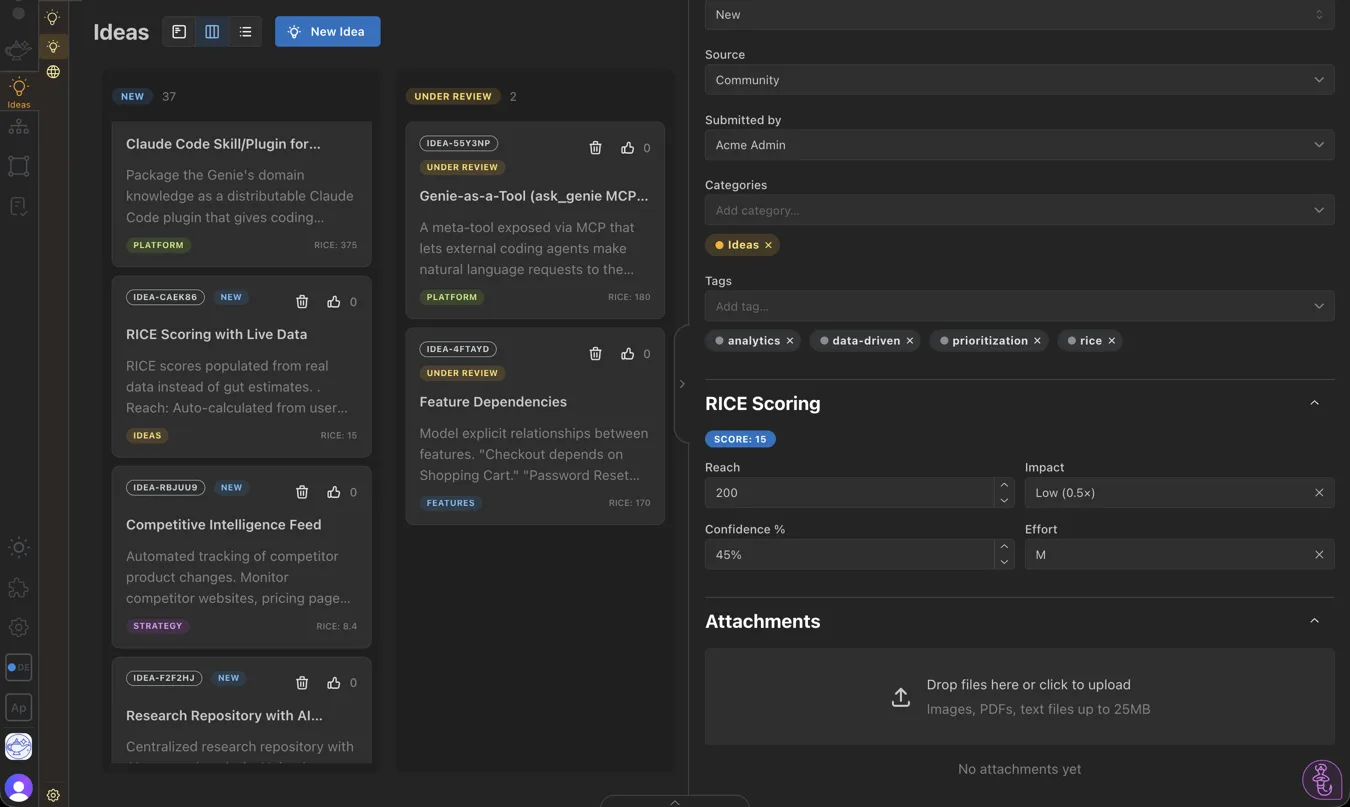

Key Features
Idea capture, RICE prioritization, card/kanban/table views, and promote-to-feature — with bidirectional project-tracker sync and spec-alignment governance.
- ✓ Capture with source, category, tags, votes, and discussion
- ✓ RICE scoring (Reach, Impact, Confidence, Effort + strategic)
- ✓ Card, kanban, and table views
- ✓ Manual market-signal data (keyword volume, CPC)
- ✓ Promote an idea straight into a structured feature
- ✓ MCP integration — agents read and write the model
- ◇ Bidirectional Jira / Linear sync Coming Soon
- ◇ Spec-alignment governance on promoted features Coming Soon

From Spark to Shipped Feature
Ideas are the beginning, not the end. Every other tool stops at capture. AppGenie carries the idea all the way to tested software through one product model.
Capture
Ideas arrive with source, category, tags, votes, and inline discussion — context attached from the first second.
Prioritize
Score with RICE and optional market-signal data. The best ideas rise for reasons you can point to.
Promote
A validated idea promotes directly into a structured feature — context intact, no export, no copy-paste.
Build
The feature carries scenarios, generates tests, and is read by AI agents via MCP. The idea becomes software.

How It Compares
Canny, Productboard, and Aha! are strong at the front of the funnel. They all treat idea management as an isolated activity. AppGenie treats it as step one of a continuous pipeline.
| Capability | Canny | Productboard | Aha! | AppGenie |
|---|---|---|---|---|
| Idea capture | Yes | Yes | Yes | Yes |
| Voting & prioritization | Yes | Yes | Yes | Yes + RICE scoring |
| Promote to feature spec | No — exports to Jira | Partial — feature cards | Partial — requirements | Yes — structured product model |
| Test generation downstream | No | No | No | Yes — via feature scenarios |
| AI-agent context | No | No | No | Yes — MCP read + write |
| Single source of truth | No | Partial | Partial | Yes — one product model |

Frequently Asked Questions
What is idea management software?
Idea management software helps teams capture, organize, evaluate, and prioritize product ideas from multiple sources — customers, team members, research, and competitive analysis. The goal is that good ideas aren't lost and prioritization is structured rather than arbitrary. The strongest tools connect ideation to downstream execution, so validated ideas become shipped features without manual translation between systems.
How is AppGenie different from Canny, Productboard, or Aha!?
Those tools are strong at the front of the funnel — capturing and organizing ideas — but they stop at ideation. Ideas must be manually exported to other tools to be built. In AppGenie, a prioritized idea promotes directly into a structured feature in your product model, with its context intact. The feature carries scenarios, generates tests, and is read by AI agents via MCP.
How does AppGenie prioritize ideas?
AppGenie supports RICE scoring — Reach, Impact, Confidence, Effort, plus an optional strategic-value weight — across card, kanban, and table views, with voting to surface team consensus. You can also add market-signal data such as keyword volume and CPC by hand to ground prioritization in real demand. RICE and market-signal values are entered manually; there is no automatic keyword-tool integration.
What is feature prioritization?
Feature prioritization is deciding which ideas to build first based on structured criteria — typically reach, business impact, confidence in the solution, and development effort. AppGenie uses RICE for exactly this, and lets you attach market-signal data so the score reflects real demand, not just internal opinion.
Can non-technical team members use it?
Yes. The Ideas module is for everyone who contributes to product decisions — design, customer success, sales, leadership, and engineering. Submitting, voting, and discussing require no technical knowledge. The technical depth lives downstream, in feature scenarios and test generation, where it belongs.
Ready to stop losing your best ideas?
Join the waitlist for early access to idea management on one product model.
Join the Waitlist →