
The Product Requirements Document That Actually Drives Development
Replace static PRDs with a living product model. Requirements become structured, testable specs that drive AI agents and automated testing.
Join the Waitlist →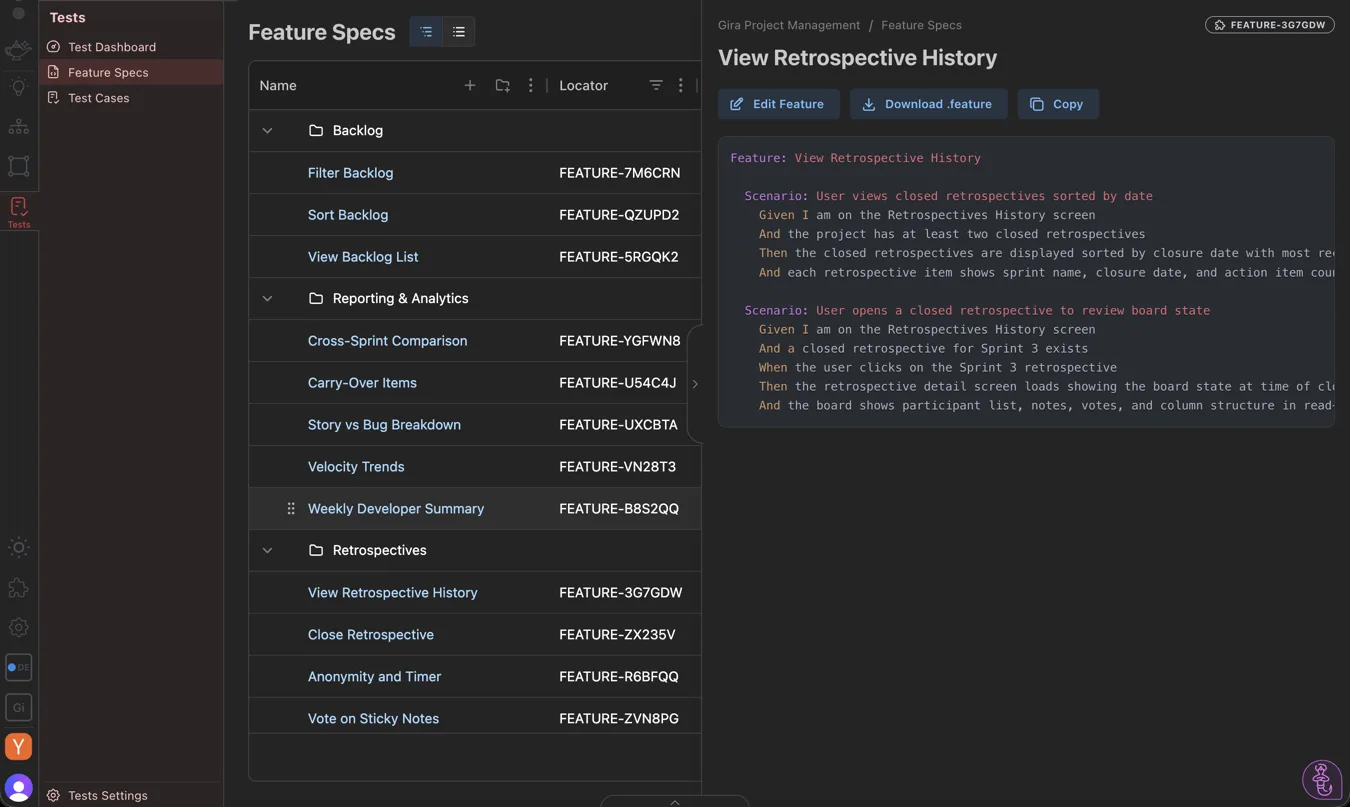

The Problem with Traditional PRDs
Teams spend days on a document developers skim and AI agents ignore. It goes stale before the first sprint ends, the tools stay disconnected, and the spec quietly becomes fiction.
They Go Stale
A PRD in Google Docs reflects what the team believed the day it was written. By sprint two, the doc and the product have diverged — nobody updates it because nobody reads it. The document is decoupled from the system it describes, so drift is inevitable.
They're Disconnected
Requirements live in one tool, user stories in Jira, tests in the codebase — and AI agents see none of it. Every handoff is a lossy translation. Ask what feature X actually does right now, and no one can answer with confidence.
They Don't Govern AI
An AI coding agent works from a prompt and some files. It doesn't know what the product is supposed to do — and a traditional PRD can't tell it, because agents don't read Google Docs. The result is AI debt: code that runs but violates product intent.

The bottleneck is no longer writing code. It's ensuring the code does what the product is supposed to do.
Structured Features,
Not Paragraphs
A requirement in AppGenie isn't a paragraph — it's a structured feature with scenarios: specific behaviors written in plain language with clear acceptance criteria. Each follows the Given-When-Then pattern BDD practitioners already know, with no framework to learn. Write in plain English; AppGenie structures it into something humans and machines can both act on.
See how BDD works →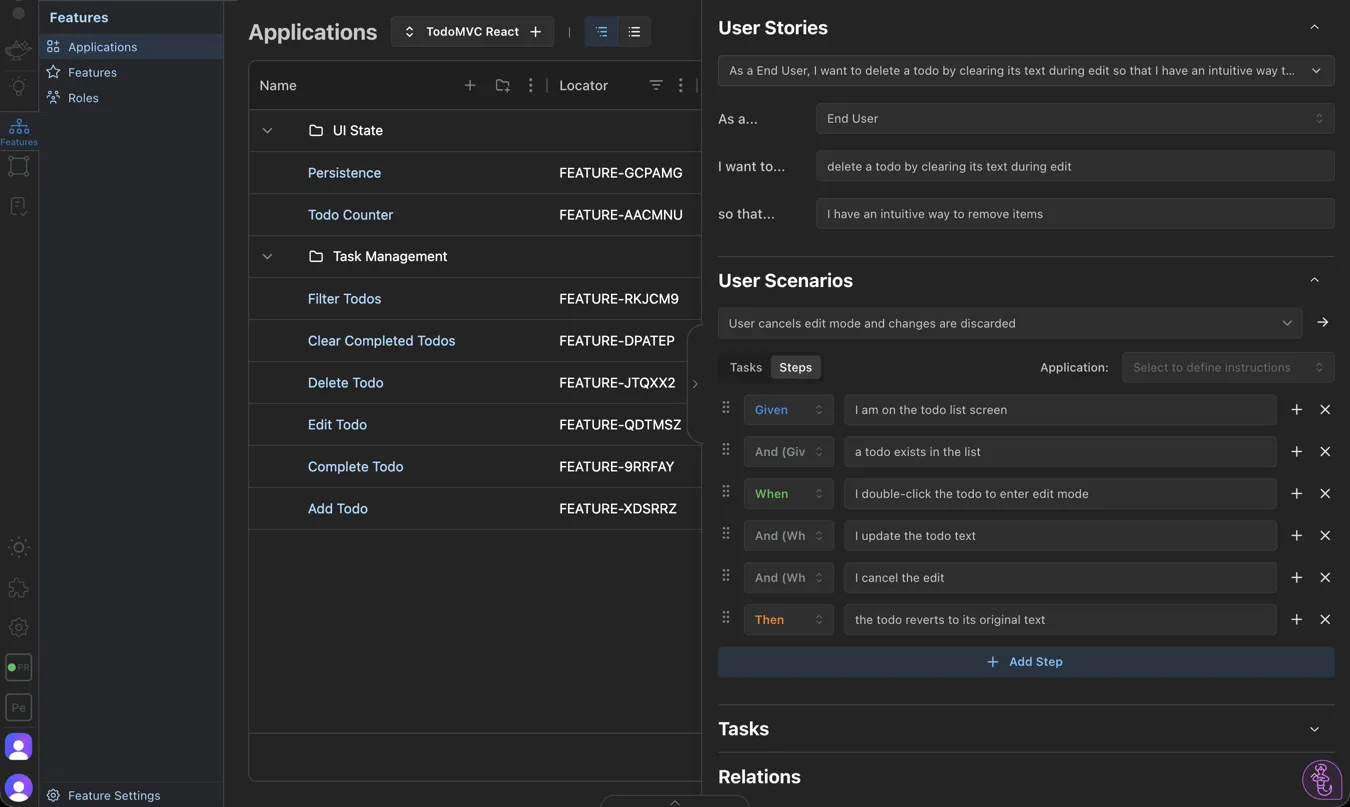
Living, Not Static
When a requirement changes, the product model updates — tests generated from the old spec are flagged, and agents reading via MCP get the current version automatically. There's no 'update the PRD' step, because the product model is the PRD. The spec evolves alongside the software and stays in sync, with no manual step and no stale artifacts. One source of truth.
What is spec-driven development? →AI-Assisted
Authoring
Writing a structured spec from scratch is slow. Describe a feature in plain language and AppGenie suggests structured scenarios from common patterns — you review, edit, and approve every one. The AI handles the formatting; you keep full control over product intent. Days to a well-structured PRD become hours, and the output is machine-readable from the start.
See the full pipeline →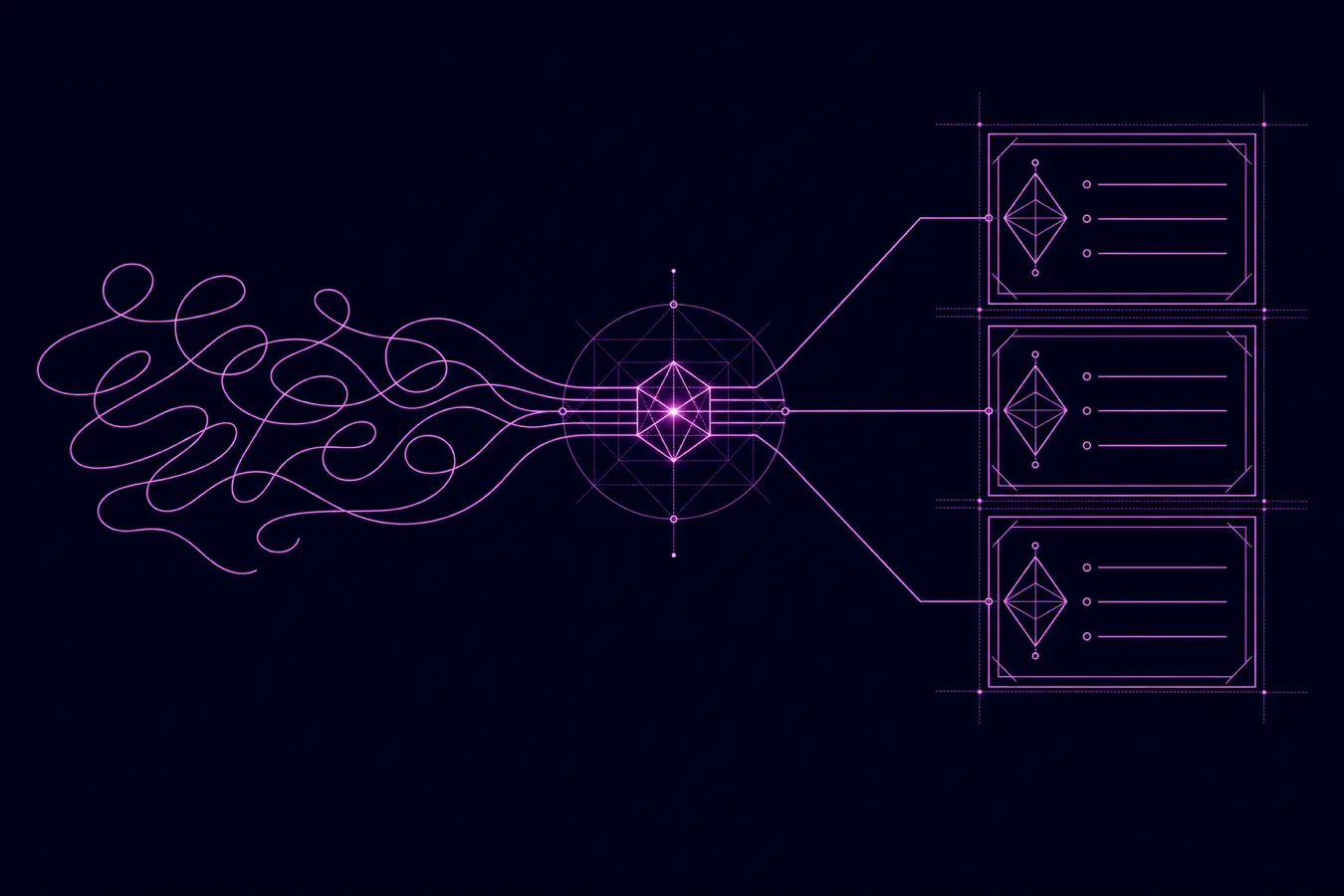
Connected to Everything Downstream
The product model isn't a documentation layer — it's the source of truth that drives the pipeline. When a scenario changes, tests regenerate. When an agent writes code, it checks the current spec first.
- ✓ Structured features with Given/When/Then scenarios
- ✓ AI-assisted scenario generation from plain language
- ✓ E2E test generation from feature scenarios
- ✓ MCP integration — coding agents read live specs
- ◇ Spec-driven governance and intent alignment checks Coming Soon
- ◇ Automated deviation detection and review gates Coming Soon

From Ideas to Tested Software
Ideas become features, features become tests, agents build against the spec. The PRD isn't a step in this pipeline — it is the pipeline. Every downstream artifact derives from the structured model, not a document someone has to keep in sync.
Capture Ideas
Ideas are captured, voted on, and prioritized in one place.
Structure Features
Promote ideas to features with scenarios and acceptance criteria.
Generate Tests
E2E tests generated directly from feature scenarios.
Align Agents
Coding agents read live specs via MCP before writing code.

How It Compares
Other tools treat the PRD as a text artifact. AppGenie treats it as structured data systems can read, validate, and act on.
| Capability | Google Docs / Confluence | Jira / Linear | Productboard | AppGenie |
|---|---|---|---|---|
| Structured requirements | No — free-form text | Partial — user stories | Partial — feature cards | Yes — structured scenarios |
| Test generation from specs | No | No | No | Yes — E2E tests from scenarios |
| AI agent context | No | No | No | Yes — MCP integration |
| Living document | Manual updates | Ticket-level only | Feature-level | Full model — auto-synced |
| Spec-driven governance | No | No | No | Coming soon |
| AI-assisted authoring | Generic AI | No | Limited | Yes — scenario-aware AI |
Frequently Asked Questions
What is a product requirements document?
A product requirements document (PRD) describes what a product should do — its features, behaviors, constraints, and acceptance criteria. Traditional PRDs are written as text documents. AppGenie structures requirements as a living product model with testable scenarios. See the PRD glossary entry for a detailed definition.
What should a PRD include?
An effective PRD includes: a clear product vision, structured features with specific behaviors described as scenarios, acceptance criteria for each feature, constraints and assumptions, and explicit scope boundaries. AppGenie captures all of these as structured data, not free-form text.
How is AppGenie different from a PRD template?
A PRD template gives you a document format. AppGenie gives you a product model — structured requirements that generate tests, provide context to AI agents, and evolve with your product. The template is a starting point. The product model is the operating system for your product development.
Can I import existing PRDs into AppGenie?
AppGenie's Ideas module accepts unstructured input — paste your existing PRD content and the AI will help structure it into features and scenarios. You can also start from scratch and build your product model iteratively.
How does a product requirements document work with AI coding agents?
AI coding agents connect to AppGenie's product model via MCP (Model Context Protocol). Before generating code, agents read structured feature specs and scenarios for business-level context — so the code they produce aligns with product intent.
Who should own the product requirements document in AppGenie?
Product managers typically own the product model, but AppGenie is designed for cross-functional collaboration. Engineers contribute technical constraints. QA reviews scenarios for testability. Everyone reads the same artifact.
Ready to replace your static PRD?
Join the waitlist for early access to the living product model.
Join the Waitlist →