
Product Strategy That Reaches the Code
Strategy usually dies in a slide deck — objectives on one side, the backlog on the other, nothing connecting them. AppGenie ties strategy to the product model: prioritize with evidence today, and — on the roadmap — trace every objective down to the feature that ships and the test that proves it.
Join the Waitlist →

Where Product Strategy Breaks Down
The failure is rarely the strategy itself. It's the gap between the objective and the work — the place where intent gets lost on the way to the code.

Strategy Lives in Slides, Work Lives in Tickets
Objectives are set at an offsite and committed to a deck. The backlog lives in a separate tracker. Nothing connects them, so by the next planning cycle the strategy is a document no one opens and the work has drifted somewhere else entirely.

Objectives Don't Survive the Backlog
Even when a goal is clear, the link to it dies on the way to engineering. A feature gets built because it was next in the queue, not because anyone can say which objective it advances. Output accumulates; outcomes stall.

Prioritization Without Strategy Is Just Triage
Scoring a backlog that is not tied to objectives optimizes locally and drifts globally — you ship the highest-scoring features and still miss the goal. A score needs an objective above it, or it is only ranking busywork.

Most product strategy is a slide nobody opens after the offsite. A strategy that can't reach the code isn't a strategy — it's a wish.
Prioritize With Evidence,
Not the Loudest Voice
The prioritization layer strategy depends on is shipped. Score work with RICE — Reach, Impact, Confidence, Effort, plus an optional strategic weight — and rank it across card, kanban, and table views. Attach market-signal data by hand: a feature tagged with 4,000 monthly searches and a $12 CPC is evidence of demand, not a hunch. Then promote a prioritized idea straight into a structured feature in the product model — so the decision reaches the code without a handoff. RICE and market-signal values are entered manually; there is no automatic keyword-tool integration.
See idea management →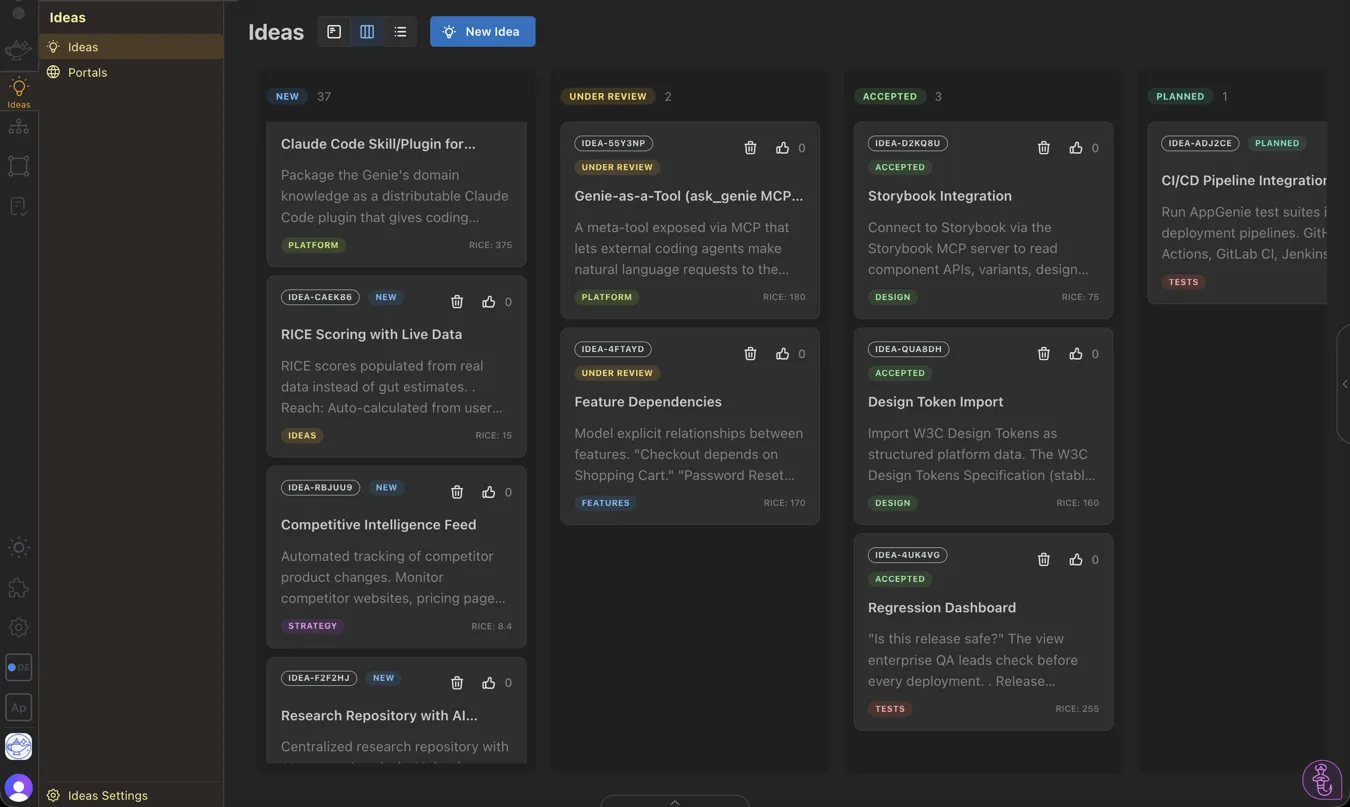

How Strategy Will Connect to Execution
Step 3 — evidence-based prioritization — and the product model it promotes into are live today. The objectives layer that frames the work (steps 1, 2, and 4) is on the roadmap.
Define Objectives
Set the objectives and key results for the cycle — the strategic layer that sits above the backlog and says what "good" means this quarter. On the roadmap.
Connect to Features
Link each objective to the features in the product model that advance it, so every piece of work traces back to a goal. On the roadmap.
Prioritize With Evidence
Score the work with RICE and attach market-signal data so the highest-leverage features rise for reasons you can defend. Live today.
Trace to Shipped Software
Objective progress rolls up from the features that actually ship and pass their tests — strategy measured by outcomes, not slideware. On the roadmap.

Strategy Disconnected vs. Strategy in the Model
Slides forget. Standalone OKR tools live next to the work instead of inside it. AppGenie ships the prioritization and product-model link today; the objectives layer that completes the picture is on the roadmap.
| Slides & Spreadsheets | Standalone OKR Tools | AppGenie | |
|---|---|---|---|
| Where strategy lives | A deck | A separate OKR app | In the product model |
| Connected to the backlog | No | Manual links | Native — features in the model |
| Connected to shipped code | No | No | Yes — via the product model |
| Evidence-based prioritization | No | Rarely | Yes — RICE + market signal (live) |
| Objectives ↔ shipped traceability | No | Partial | On the roadmap |

Key Features
Evidence-based RICE prioritization linked to your product model, with an objectives/OKR module that frames the work against strategy.
- ✓ RICE prioritization (Reach, Impact, Confidence, Effort + strategic weight)
- ✓ Manual market-signal data (keyword volume, CPC) on the work
- ✓ Card, kanban, and table prioritization views
- ✓ Promote prioritized ideas straight into features in the product model
- ✓ MCP — agents read the prioritized model and write changes back
- ◇ Objectives & key results (OKR) module Coming Soon
- ◇ Link features to strategic objectives Coming Soon
- ◇ Objective progress rollup from shipped, tested features Coming Soon
- ◇ Strategy-to-execution traceability views Coming Soon
- ◇ Initiative and theme planning Coming Soon

Frequently Asked Questions
What is product strategy?
Product strategy is the set of choices that connect a product vision to the work a team actually does: which problems to solve, for whom, in what order, and why. A strategy answers "what are we building and what are we deliberately not building," then makes those choices traceable down to the features that ship. Strategy that cannot reach the backlog is decoration — the value is in the link between objectives and execution.
What is product strategy software?
Product strategy software helps teams define objectives, prioritize work against them, and trace strategic goals down to shipped features. Most tools handle one slice — OKRs in one app, prioritization in another, roadmaps in a third — leaving the connection between strategy and execution to manual upkeep. AppGenie keeps strategy in the same product model the work lives in, so objectives and features need not drift apart.
How is OKR software different from a product roadmap?
OKRs (Objectives and Key Results) define what you want to achieve and how you will measure it — outcomes. A roadmap describes what you plan to build and when — outputs. OKRs set the destination; the roadmap is the route. They work best linked, so each roadmap item advances a measurable objective rather than existing on its own.
Does AppGenie have OKRs or a strategy module today?
Evidence-based prioritization is shipped: RICE scoring with an optional strategic-value weight, plus manually entered market-signal data such as keyword volume and CPC, across card, kanban, and table views — see idea management. A dedicated objectives/OKR module — setting objectives, linking them to features, and rolling progress up from shipped, tested work — is on the roadmap, not yet available.
How does product strategy connect to execution?
Strategy connects to execution through the product model. Prioritized ideas promote directly into structured features that carry scenarios, generate tests, and are read by AI agents over MCP — so a decision about what to build reaches the code without a translation layer. The objectives layer that will frame those decisions against measurable goals is on the roadmap; the prioritization-to-feature link is live today.
Connect your strategy to what actually ships
Join the waitlist. The objectives layer is coming.
Join the Waitlist →