
AI Coding Agents, Building to Spec
Your team ships faster with AI agents — and your review surface exploded. AppGenie has agents read your product model before they generate, and tests built from your specs verify the output, right inside the CI/CD you already run.
Join the Waitlist →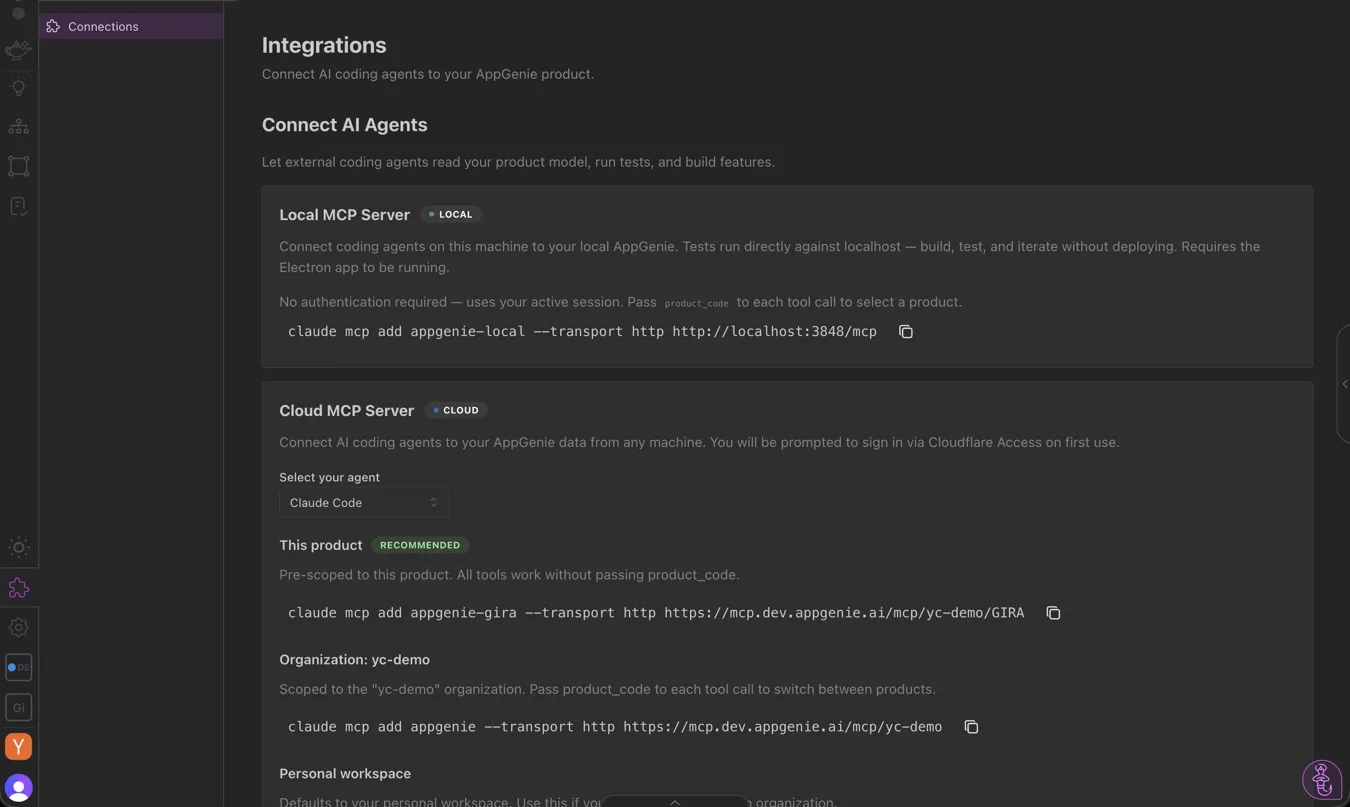

The Governance Gap Opens at Scale
AI agents generate code faster than your team can review it, and they build against context they were handed — not the product intent they never saw. More dashboards don't close that gap; product-level verification does.

Review Surface Grew Faster Than the Team
Your team adopted AI coding agents and velocity jumped — but so did the volume of code waiting on a human to read it. Blanket "review every PR" policies collapse the moment agents generate faster than people can keep up.

Agents Optimize for What They See
An agent doesn't know the payment endpoint needs rate limiting because a spec says so. It optimizes for code correctness — what it can see — not product intent, which lives in a doc it never read. The gap is invisible until something ships wrong.

Observability at the Wrong Layer
Token counts and latency graphs tell you how much an agent generated. They don't tell you whether what it built matches what the product is supposed to do. That's the question an engineering manager actually has to answer.

Most tools tell you how much an agent generated. The question you actually have to answer is whether what it built matches what the product is supposed to do.
Govern at the Layer of
Product Intent
Agent output drifts from intent when nothing structurally connects the spec to the code. AppGenie closes the loop where it counts: agents read the product model through MCP before they generate, and tests built from your scenarios check the result. Today that verification is live. The vision on top — a dashboard that maps agent work to features and review gates that fire on deviation — is on the roadmap, and we say so plainly.
See AI agent management →
Test Failures That Point
to a Requirement
When a generated test fails, you don't get 'test_checkout_flow failed.' You get the scenario it traces to — the specific behavior the agent didn't satisfy. Tests are generated from your product scenarios, run as standard Playwright in your CI/CD, and map every failure back to the requirement it verifies. The spec becomes the check, automatically.
Explore AI E2E testing →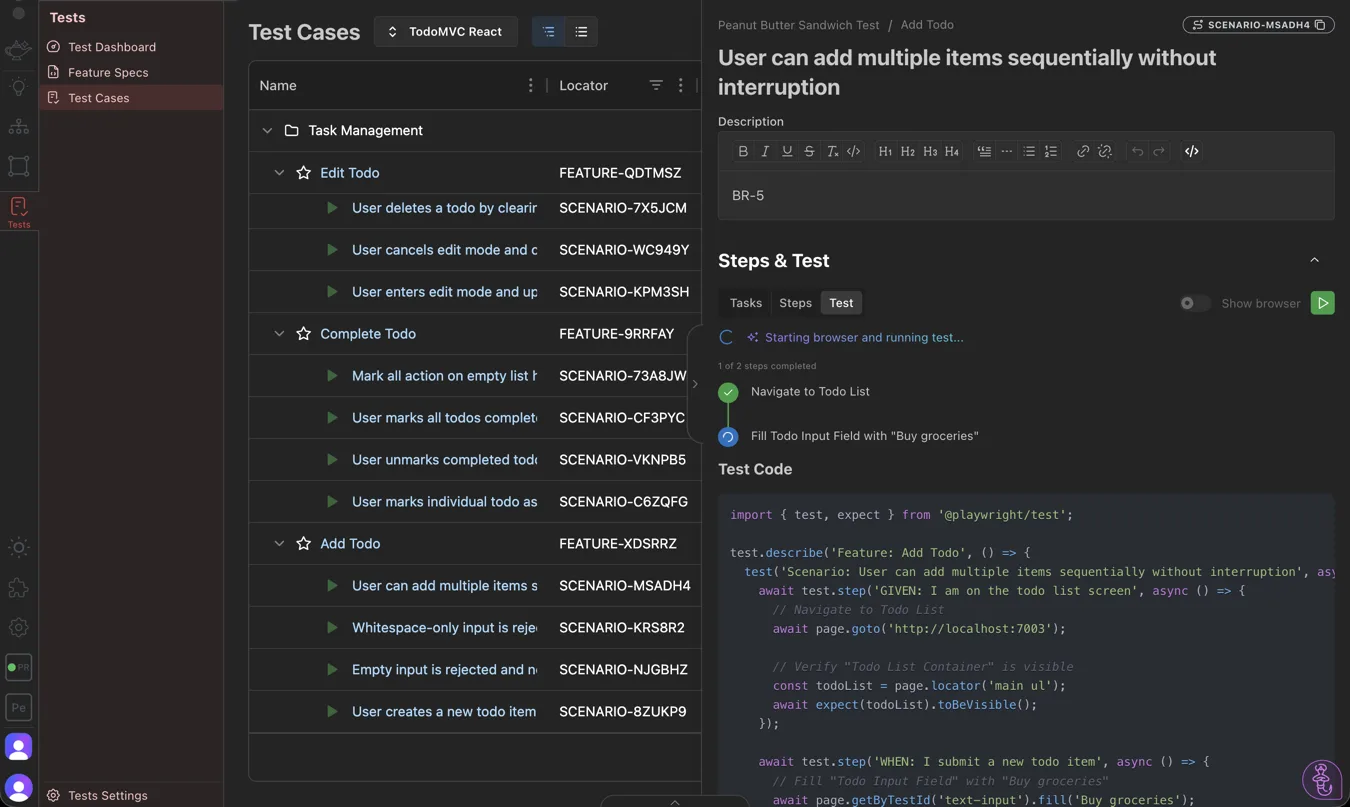

Key Features
Agents read the product model and tests from specs run in your pipeline — with dashboard and review-gate layers on top.
- ✓ MCP integration — agents read and write the product model
- ✓ E2E tests generated from your product scenarios
- ✓ Standard Playwright output — runs in your existing CI/CD
- ✓ Structured product model as shared agent context
- ✓ Test failures map to a scenario, not just a line of code
- ◇ Agent activity dashboard — work mapped to features Coming Soon
- ◇ Product-aware human review gates on deviation Coming Soon
- ◇ Specification-deviation detection Coming Soon

How It Fits Your Workflow
No new framework, no migration. AppGenie sits above the tools your team already runs and closes the spec-to-output loop.
Connect Your Agents
Point Claude Code, Cursor, or any MCP agent at the model. Your workflow doesn't change.
Agents Read the Spec
Before generating, agents pull structured product context — features, scenarios, criteria.
Tests Verify Output
E2E tests generated from those scenarios run in your CI/CD against what the agent built.
Govern the Deviations
Coming soon: a dashboard maps agent work to features and review gates fire on drift.

A Different Layer Than Observability
Token-and-latency tools watch the infrastructure. AppGenie watches whether the product got built the way you specified it.
| Capability | Token/latency observability | AppGenie |
|---|---|---|
| Agents get structured product context | No | Yes — MCP read + write |
| Output verified against the spec | No | Yes — tests from scenarios |
| Test failures map to a requirement | No | Yes — scenario-level |
| Runs in your existing CI/CD | Varies | Yes — standard Playwright |
| Work mapped to product features | No | Coming soon |
| Review gates fire on deviation | No | Coming soon |
Frequently Asked Questions
How does AppGenie help engineering managers?
AppGenie connects velocity to quality. Today, AI coding agents read your structured product model through MCP before they generate code, and tests generated from your specs verify the output. Product-level visibility and human review gates are on the roadmap — see AI agent management for where that's headed.
Does AppGenie replace code review?
No. Code review catches bugs, security issues, and architectural problems that need human judgment. AppGenie verifies whether the code does what the product specification says — automatically, through tests generated from scenarios. Reviewers shift from "does this match the spec?" toward "is the architecture sound?"
How do AppGenie tests integrate with existing CI/CD pipelines?
AppGenie generates standard Playwright tests that run in your existing pipeline — GitHub Actions, GitLab CI, Jenkins, whatever you use. No proprietary runner, no migration from your current suite. AppGenie is the specification-to-test layer; your infrastructure runs the tests.
What is product-intent governance, and what's actually shipped?
Product-intent governance is oversight anchored to what the product should do, not just what the code does. The verification layer is live today — agents read the model via MCP and tests from scenarios validate their output. The dashboard and review-gate layers are on the roadmap; we mark them coming soon rather than imply they exist.
Does AppGenie replace Jira or Linear?
No. AppGenie is the product-intent layer above your tracker. Jira and Linear manage who works on what; AppGenie owns the specification and validates that implementations match it. Most teams run both.
Velocity without governance is just fast failure.
Join the waitlist for early access.
Join the Waitlist →