
Product Management for Teams That Build with AI
Jira tracks tasks. Productboard collects feedback. Neither talks to your AI agents. AppGenie is product management built on a living product model — structured, testable, and read directly by the agents writing your code.
Join the Waitlist →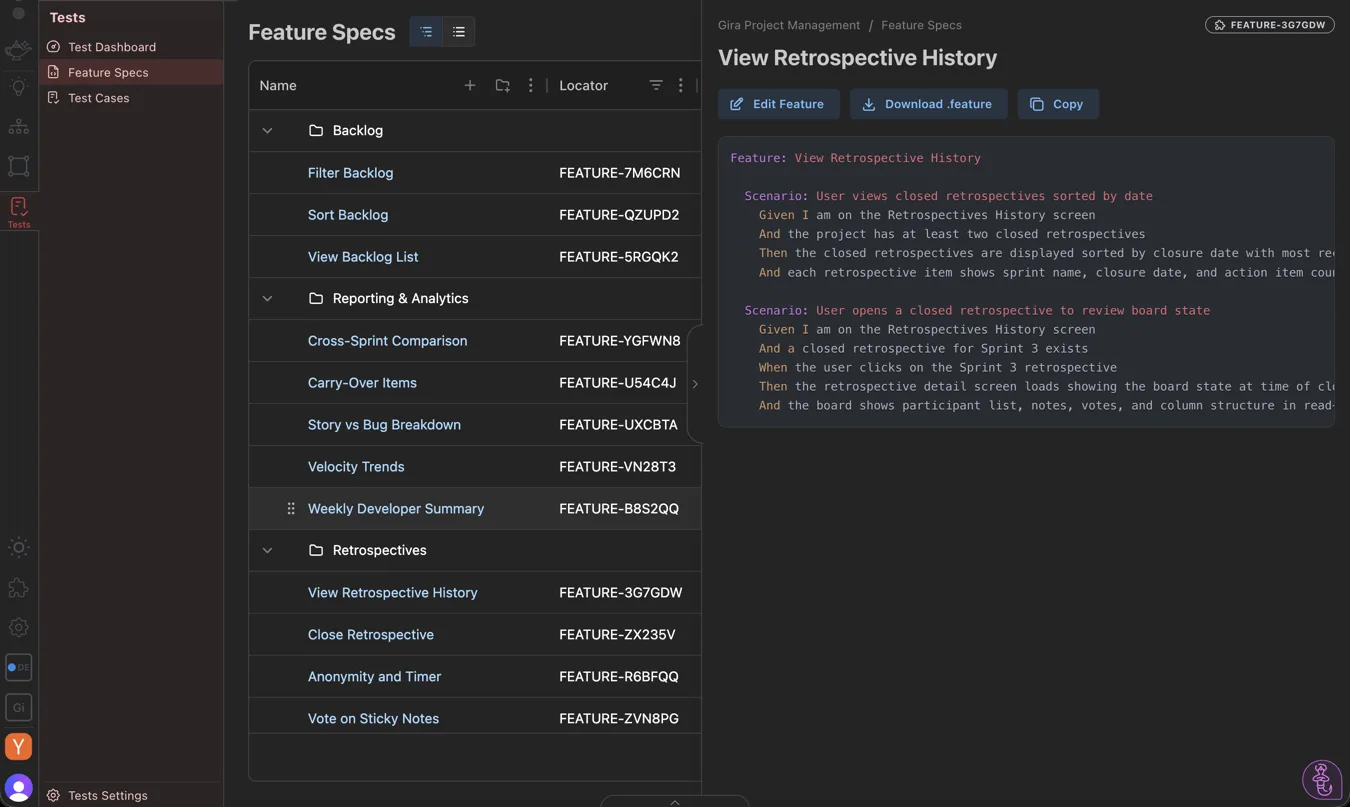

PM Tools Were Built for a World Before AI Agents
Jira tracks developer tasks. Productboard organizes requests. Linear manages sprints. Each assumes a human reads the requirement and a human writes the code. That assumption is breaking.

No Connection to Agents
Jira, Linear, and Productboard don't expose structured specs to AI coding agents. The agent works from a prompt derived from a ticket — a lossy translation of the requirement. Every detail lost in that handoff is a future misalignment.

Features Without Tests
Traditional PM tools manage feature definitions and user stories, but they don't generate tests. The test suite is a separate artifact in a separate tool — nothing structurally connects what the PM specified to what the tests verify.

Requirements That Stop at the Doc
A PRD in Notion or Confluence is static. No system reads it programmatically, no agent references it during code generation, no test validates against it. It describes intent but enforces nothing. It's a wish list, not a specification.

The gap between product intent and agent behavior is where quality breaks down. Most PM tools can't even see the gap.
A Product Model,
Not a Ticket Board
AppGenie isn't task management. The product model is a structured representation of your product — features, scenarios, acceptance criteria, and roles — that every downstream system reads from. Ideas promote to features, features carry scenarios, scenarios generate tests, and agents read the whole model. It isn't a workflow. It's an architecture for product intent.
What is a product model? →
Prioritize With Evidence,
Not Volume
Feature prioritization shouldn't be a popularity contest. AppGenie's Ideas module scores with RICE — Reach, Impact, Confidence, Effort, plus an optional strategic-value weight — across card, kanban, and table views. Capture ideas, vote, categorize, and add market-signal data by hand when you have it. Then promote the winners straight into structured features.
Explore idea management →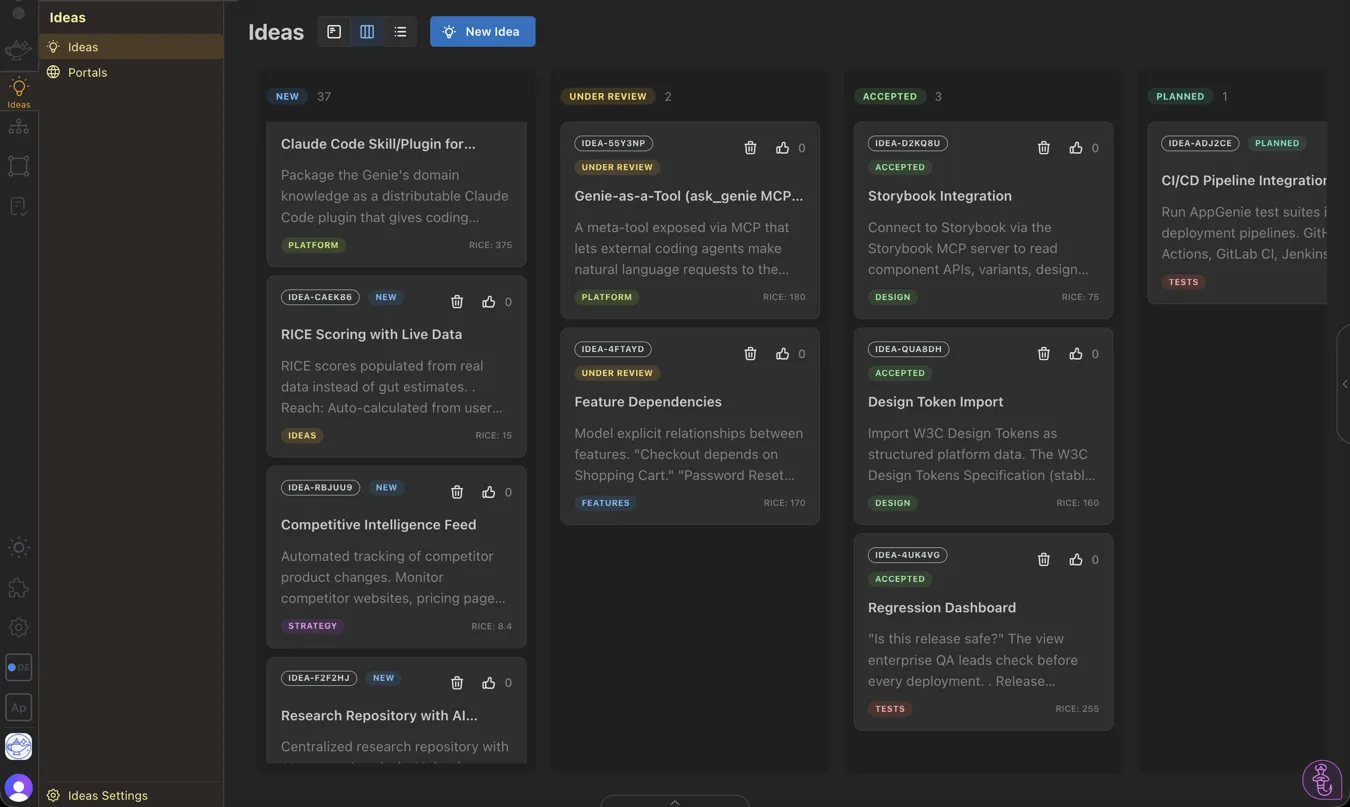

Key Features
A structured product model that agents read and write, tests generated from your specs, and the roadmap, sprint-planning, and project-tracker-sync views built on top.
- ✓ Living product model — features, scenarios, acceptance criteria
- ✓ Given/When/Then specs with reusable step phrases
- ✓ E2E test generation directly from scenarios
- ✓ MCP integration — agents read and write the model
- ✓ Ideas with RICE scoring (card, kanban, table views)
- ✓ Roles, user stories, and applications
- ◇ Roadmap and sprint views Coming Soon
- ◇ Jira / Linear bidirectional sync Coming Soon
- ◇ Spec-driven governance and intent-alignment checks Coming Soon

From Idea to Tested Software
Ideas become features, features become tests, agents build against the spec. Product management stops being a backlog you maintain and becomes the source of truth that drives the build.
Capture & Prioritize
Ideas are captured, voted on, and scored with RICE in one place.
Structure Features
Promote ideas to features with scenarios and acceptance criteria.
Generate Tests
E2E tests generate directly from the feature scenarios.
Align Agents
Coding agents read live specs via MCP before they write code.

How It Compares
AppGenie doesn't compete on task tracking or sprint management. It occupies a different layer — the product-intent layer that sits above your execution tools.
| Capability | Jira | Productboard | Linear | AppGenie |
|---|---|---|---|---|
| Structured product model | No | Partial — feature cards | No | Yes — features + scenarios |
| Specs AI agents can read | No | No | No | Yes — MCP read + write |
| Test generation from specs | No | No | No | Yes — E2E from scenarios |
| Idea capture + RICE scoring | Limited | Yes | No | Yes — card/kanban/table |
| Roadmaps & sprint planning | Yes | Roadmaps | Yes | Coming soon |
| Project tracker sync | — | Partial | — | Coming soon |

Frequently Asked Questions
What is product management software?
Product management software helps teams define, prioritize, and deliver product features. Traditional tools focus on task tracking (Jira, Linear) or feedback organization (Productboard, Aha!). AppGenie focuses on the product model — a structured, testable specification of what your product does, connected to AI coding agents and automated test generation.
How is AppGenie different from Productboard?
Productboard excels at collecting customer feedback and communicating roadmaps. AppGenie starts where Productboard stops — turning product requirements into structured, testable scenarios that drive AI agent behavior and generate tests. Productboard tells you what to build; AppGenie helps ensure it gets built correctly.
Is AppGenie a Jira replacement?
No. Jira and AppGenie solve different problems. Jira is a task tracker — it manages who works on what and when. AppGenie is a product-intent layer — it defines what the product should do and connects that intent to tests and AI agents. Most teams will use both. Bidirectional Jira and Linear sync is on our roadmap.
What is a product model?
A product model is a structured, machine-readable representation of your entire product — its features, scenarios, acceptance criteria, and roles. Unlike a PRD or a backlog, it is not a document. It is a live data structure that AI agents read (and write to) and that tests reference. It is the foundation that makes spec-driven development possible.
Do I need to use AI coding agents to benefit from AppGenie?
No. The structured product model, scenario-based feature definitions, RICE prioritization, and test generation are valuable whether or not your team uses AI agents. But the full value — agents reading and writing the model, alignment between spec and code — is clearest when AI agents are part of your development process.
Ready to manage products, not just tasks?
Join the waitlist for early access to the living product model.
Join the Waitlist →