
Govern What Your AI Agents Build
AI coding agents ship faster than anyone can review — and passing tests doesn't mean they built the right thing. AppGenie connects agents to a structured product model they read and write over MCP, so there's a source of truth to govern against. Product-intent governance, built on a foundation that's live today.
Join the Waitlist →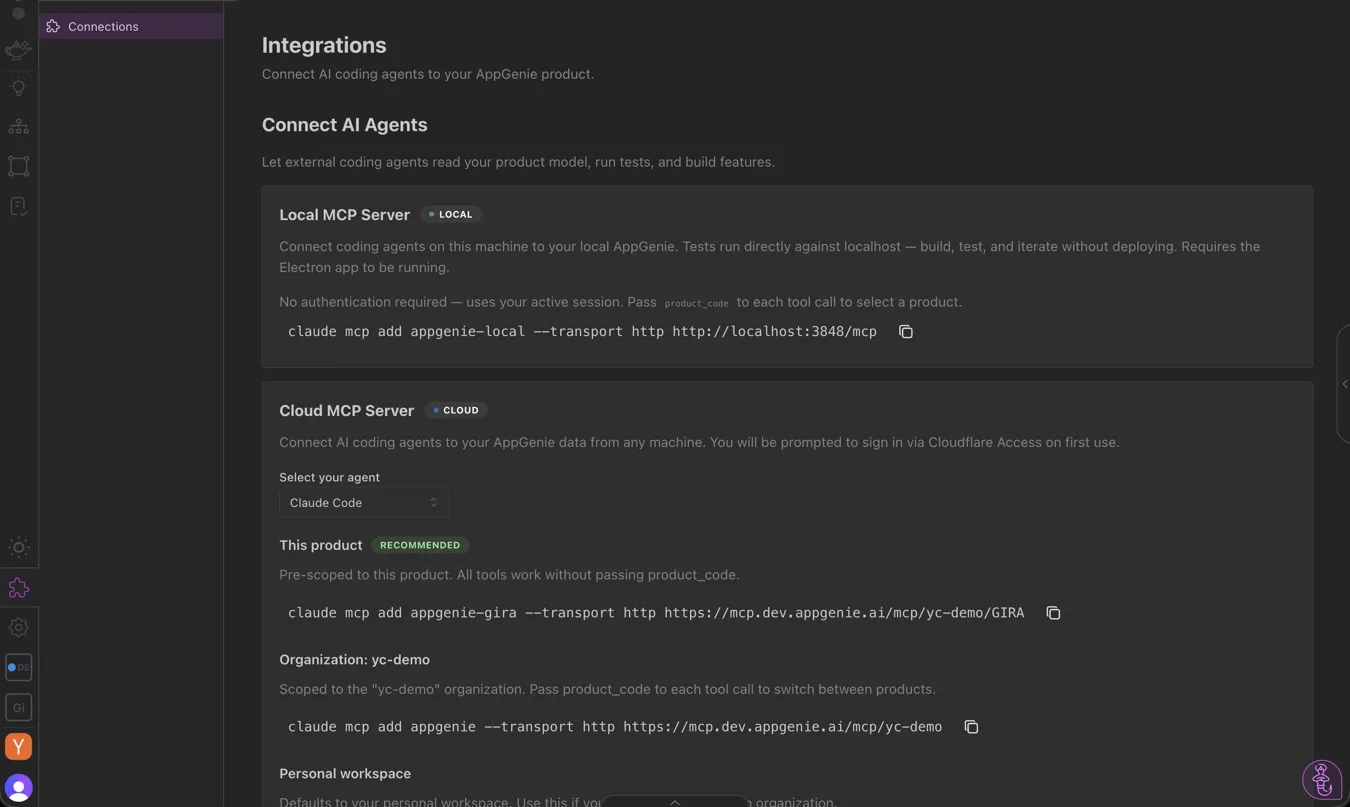

The Governance Gap
AI agents made building cheap. They did not make knowing what got built any easier. The gap between an agent's output and a product's intent is where quality quietly erodes.

Agents Build Faster Than Anyone Can Review
AI coding agents now write a large and growing share of production code. Output volume has outrun human review capacity — the bottleneck moved from writing software to verifying that the right software got built.

Speed Without Intent Is Just Faster Drift
An agent can produce code that compiles, passes its tests, and still builds the wrong thing. Passing tests is not the same as matching intent. Without a definition of intent to check against, "correct" is unverifiable.

You Can't Govern What You Can't Compare
Governance needs a reference. Logs and traces tell you what an agent did, not whether it did what you meant. The missing artifact is a machine-readable statement of what the product is supposed to do.

You wouldn't merge a pull request no one reviewed. AI agents are writing more of your product than anyone — against an intent nothing is checking.
Agents Already Work Against
Your Product Model
Governance starts with a source of truth. In AppGenie your product is a structured model — features, scenarios, acceptance criteria, the full screen-and-element hierarchy — that AI coding agents read before they build and write structured changes back to, over MCP. That bidirectional link is live now, across Claude Code, Cursor, and Windsurf. It is the prerequisite everything else rests on: a machine-readable record of what the product is supposed to do, with agents already connected to it.
What is a product model? →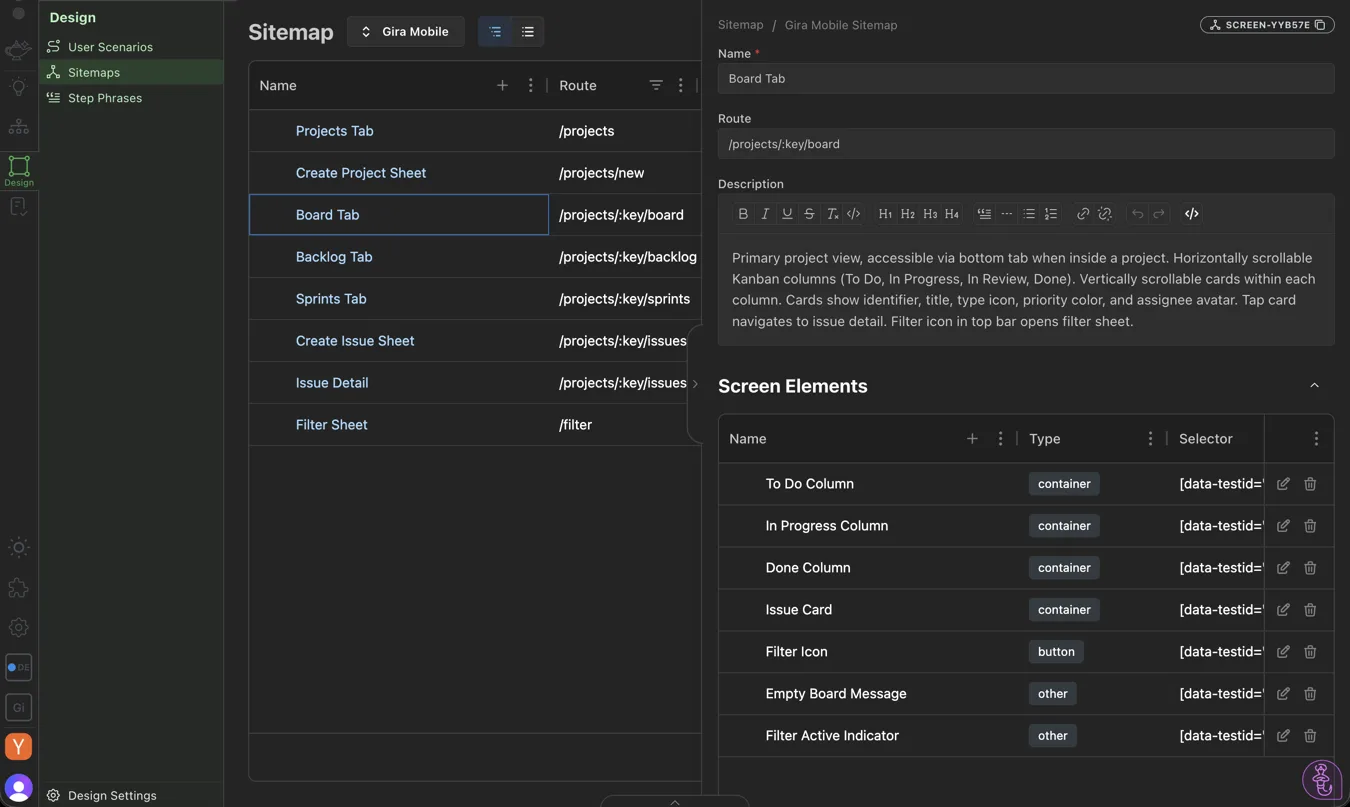
Product-Intent Governance,
Built on the Model
The governance layer we're building sits on top of that model. Every change an agent proposes will be checked against the product's stated intent before it lands. Output that conforms flows through; output that diverges will be surfaced for review with the specific deviation named — not 'something changed,' but 'this contradicts the scenario you defined.' The goal is simple and not yet shipped: let agents move at full speed while keeping every change accountable to what the product is meant to do.
See the platform vision →

How Product-Intent Governance Will Work
Steps 1 and 2 — agents reading intent and writing changes back over MCP — are live today. Steps 3 and 4, the conformance check and deviation review, are on the roadmap.
Read Intent
Before writing code, an agent pulls the relevant features, scenarios, and acceptance criteria from the product model over MCP. It starts from defined intent, not guesswork. (Live today.)
Build & Write Back
As the agent works, structured changes flow back into the model over MCP — so intent and implementation stay linked instead of diverging silently. (Live today.)
Check Against Intent
Each proposed change will be evaluated against the model’s stated behavior: does it satisfy the scenarios, or contradict them? This conformance check is on the roadmap.
Surface Deviations
Conforming changes will pass through; divergent ones will be flagged for review with the exact intent they break — not a vague diff — and routed to the right owner. On the roadmap.

Observability Tells You What Happened.
Governance Tells You If It Was Right.
Agent observability and product-intent governance are different layers solving different problems. AppGenie ships the product model that makes the right-hand column possible; the governance layer itself is on the roadmap.
| Question | Agent Observability | Product-Intent Governance |
|---|---|---|
| What it watches | Runtime: tokens, latency, traces, tool calls | Output vs. intended product behavior |
| Question it answers | Is the agent running correctly? | Did the agent build the right thing? |
| Source of truth | Logs and execution traces | The structured product model |
| What it catches | Errors, cost spikes, broken tool calls | Silent drift from product intent |
| When it acts | After execution — monitoring | Against the spec, before changes land |

Key Features
A structured product model that AI coding agents read and write over MCP, with a governance layer that checks their output against product intent.
- ✓ Structured product model as the source of intent
- ✓ MCP read access — agents read scenarios and specs before building
- ✓ MCP write access — agents write structured changes back to the model
- ✓ Generated tests as an automated conformance signal
- ✓ Reusable scenarios and acceptance criteria per feature
- ◇ Product-intent governance dashboard Coming Soon
- ◇ Agent change review queue Coming Soon
- ◇ Automated deviation / drift detection Coming Soon
- ◇ Intent-conformance checks in CI Coming Soon
- ◇ Per-agent audit trails and approval workflows Coming Soon

Frequently Asked Questions
What is AI agent management?
AI agent management is the practice of directing, monitoring, and governing autonomous AI coding agents so their output stays aligned with what a product is meant to do. It spans two layers: observability (watching what agents do at runtime) and governance (checking whether what they built matches intended product behavior). As agents write more of the code, management shifts from writing software to verifying that the right software got built.
What is product-intent governance?
Product-intent governance is checking AI agent output against a machine-readable definition of what the product is supposed to do — features, scenarios, and acceptance criteria — not only against whether the code runs. It answers a question observability cannot: did the agent build the right thing? It depends on a structured product model that agents read from and write to.
How is AI agent governance different from AI agent observability?
Observability watches runtime behavior — tokens, latency, traces, tool calls — and answers "is the agent running correctly?" Governance compares output to intended behavior and answers "did the agent build the right thing?" Observability catches errors and cost spikes; governance catches silent drift between what an agent produced and what the product was meant to do. They are complementary, and governance needs a product model as its reference.
Can you control what AI coding agents build?
You can control the inputs and the verification. AppGenie gives agents a structured product model to read before they build — so they start from defined intent — and generated tests that verify behavior. The governance layer that checks each change against intent and flags deviations is on the roadmap; the model and MCP foundation it builds on are live today.
Does AppGenie have agent governance today?
The foundation is shipped: a structured product model, bidirectional MCP access so agents read intent and write changes back, and generated tests as a conformance signal. The governance layer itself — a dashboard, change review queue, automated deviation detection, and intent-conformance checks in CI — is on the roadmap. AppGenie is the broader AI-native product development platform this governance layer lives inside.
Govern what your agents build — starting with the model
Join the waitlist for early access to product-intent governance.
Join the Waitlist →