
End-to-End Testing That Tests What Your Product Should Do
Traditional E2E tests break every time the UI changes — and AI-generated code changes constantly. AppGenie generates tests from your product model instead, then heals them from the spec when the code moves. Anchored to intent, not implementation.
Join the Waitlist →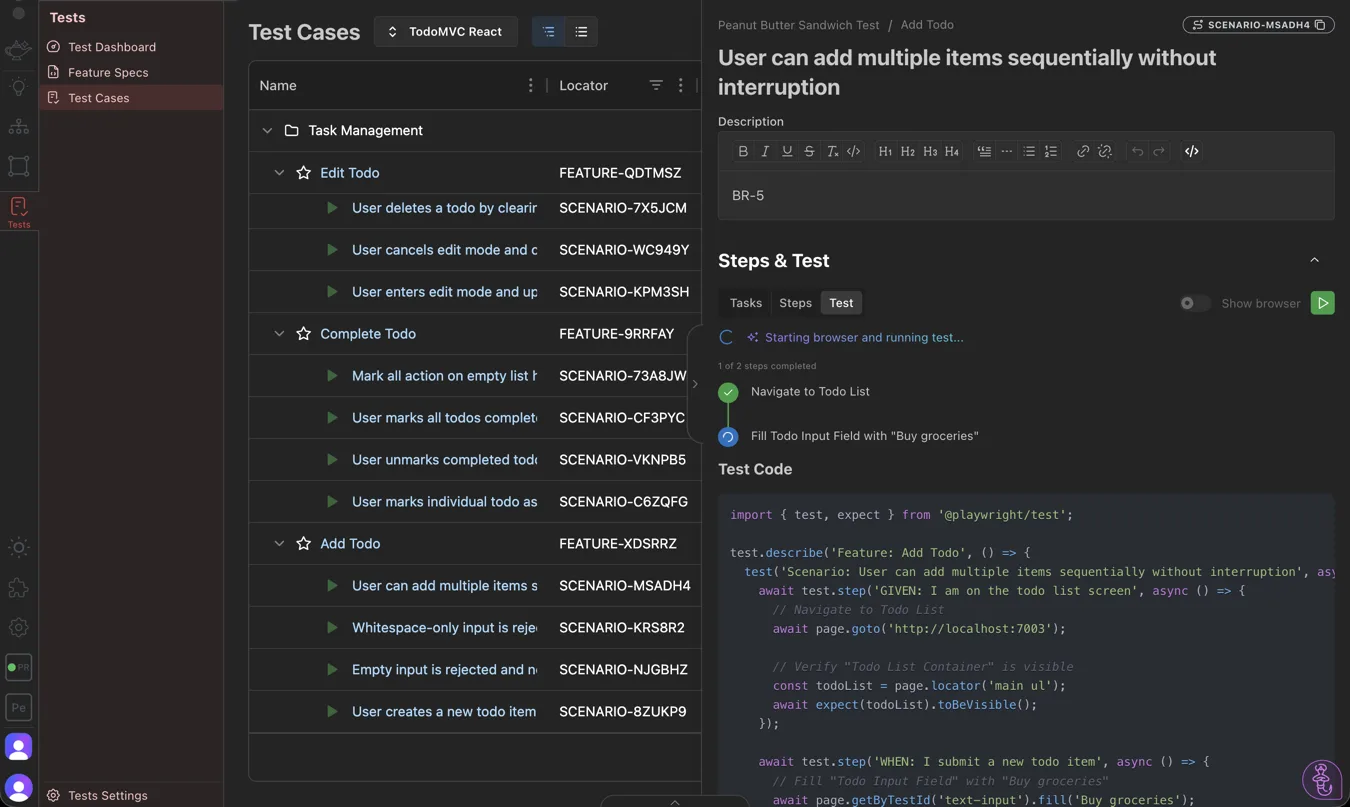

E2E Testing Is the Most Fragile Code You Own
It's the closest thing to a real user walking through your product — and the most expensive, brittle, and hated category of testing in software. AI-generated code is making it worse, fast.

Coupled to Implementation
A traditional E2E script clicks a specific selector, waits for a specific element, asserts a specific value. Rename a class, move a field, redesign a page — the test breaks. It's coupled to details that have nothing to do with what the product is supposed to do.

AI-Generated Code Makes It Worse
Agents restructure components, rename classes, reorganize the DOM — often while preserving correct behavior. Every one of those changes breaks an implementation-coupled test. In codebases where agents write most of the code, suites break faster than humans can repair them.

The Suite Doesn't Know the Intent
A test verifies that code behaves a certain way. It doesn't know whether that behavior is correct per the specification. When an agent ships an endpoint with no rate limiting, the suite passes — because no one remembered to write that test. Coverage is whatever the author recalled.

The test suite verifies that the code runs. It has no idea whether the code does what the product was supposed to do.
Anchored to Intent,
Not Implementation
AppGenie generates tests from your product model — a structured specification of what the product should do — instead of from selectors that describe how it currently does it. The specification is stable; the code is volatile. Anchor your tests to the stable thing and a redesign stops being a test-suite emergency. When a change does break a test, an AI healing loop regenerates it from the unchanged spec.
What is spec-driven development? →
Tests Heal —
They Don't Pile Up
In codebases where agents write most of the code, suites can break dozens of times a week, each break a manual triage. AppGenie closes that loop: when a test fails because the implementation moved, the AI healing loop regenerates it from the scenario it was born from. You watch runs execute step by step — pass, fail, and heal — instead of drowning in red you have to fix by hand.
See how it compares ↓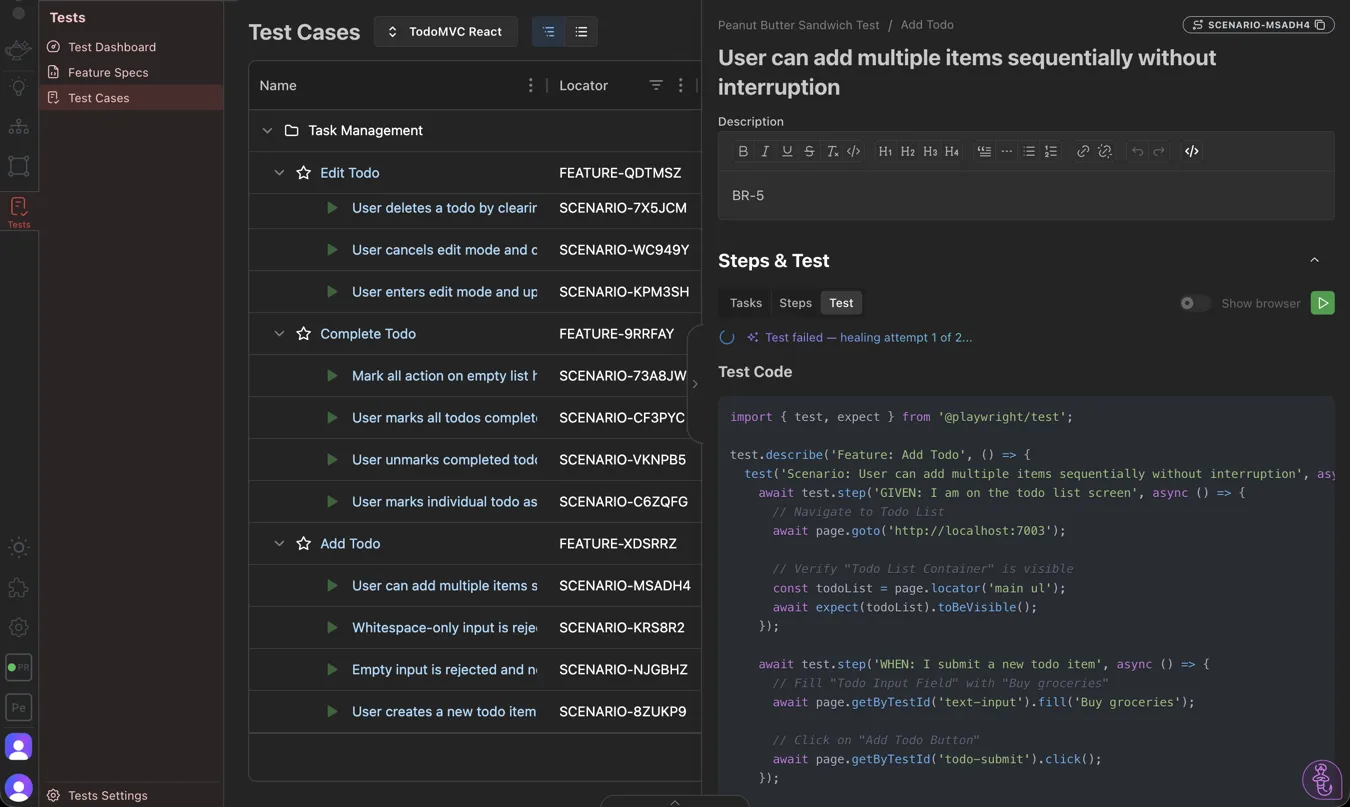

Key Features
End-to-end tests generated from your BDD scenarios, a self-healing loop, execution, and MCP read/write — with autonomous agentic execution and CI-native intent checks.
- ✓ E2E tests generated from Given/When/Then scenarios
- ✓ Playwright output with a Page Object Model structure
- ✓ AI healing loop — regenerate broken tests from the spec
- ✓ Test execution with step timeline and pass/fail detail
- ✓ Batch runner and real-time run monitoring
- ✓ MCP integration — agents read and write the model
- ◇ Visual agentic test execution (autonomous run) Coming Soon
- ◇ CI-native intent-alignment / coverage checks Coming Soon

From Scenario to Self-Healing Test
Spec-driven E2E testing is a loop, not a one-way export. The product model defines what to test; AppGenie generates and heals; your runner executes.
Define Scenarios
Write the behaviors the product must exhibit as Given/When/Then scenarios in the product model.
Generate Tests
AppGenie generates executable Playwright tests, structured with a Page Object Model, from those scenarios.
Run & Monitor
Tests run in real browsers — step timeline, pass/fail, batch runs, real-time monitoring.
Heal, Don't Triage
When code changes break a test, the AI healing loop regenerates it from the unchanged spec.

Spec-Driven vs. Traditional E2E
AppGenie doesn't replace Cypress or Playwright — it generates Playwright tests that run on them, and adds the layer they're missing: the connection between what the product should do and what the tests verify.
| Dimension | Traditional E2E (Cypress, Playwright) | AppGenie Spec-Driven Tests |
|---|---|---|
| Test source | Hand-authored selectors and assertions | Product-model scenarios |
| Breaks when | UI changes, DOM restructuring, CSS updates | Product behavior changes |
| When a test breaks | A human triages and rewrites it | AI healing regenerates it from the spec |
| AI-agent friendly | No — agents constantly break the suite | Yes — heals as the code evolves |
| Knows product intent | No — verifies code, not requirements | Yes — verifies scenarios |
| Coverage gaps | Whatever the author forgot | Whatever the model is missing — and visible |

Frequently Asked Questions
What is end-to-end testing?
End-to-end (E2E) testing verifies that an application works correctly from the user's perspective by simulating real user workflows — clicks, form inputs, navigation, and data flow across the entire system. It exercises the full stack: frontend, backend, database, and integrations. It is the broadest form of automated testing, and the closest thing to a real user walking through your product. It's also the most fragile and expensive to maintain — which is the problem spec-driven development sets out to fix.
How does AppGenie make E2E tests survive code changes?
Tests are generated from the product model — a stable specification of what the product should do — not authored against volatile implementation details. When a code change does break a test, AppGenie's AI healing loop regenerates the affected test from the unchanged spec, rather than leaving an engineer to triage and rewrite it by hand. The spec is stable; the code is volatile; the tests are anchored to the stable thing.
Can I use AppGenie with Cypress or Playwright?
AppGenie generates Playwright tests, structured with a Page Object Model, that run on your existing infrastructure — locally or in CI/CD. It doesn't replace your runner; it generates the tests your runner executes. The product model defines what to test; your framework defines how to execute it.
What is agentic testing?
Agentic testing uses AI to generate, maintain, and adapt test scenarios rather than relying on hand-written, fixed scripts. AppGenie's approach generates tests from structured scenarios and heals them through an AI loop as the implementation changes — so the suite gets more reliable as AI-generated code accelerates, not less.
How does this relate to BDD?
AppGenie's scenarios are behavior-driven — Given/When/Then, natural language, stakeholder-readable. The difference from classic BDD is that AppGenie generates the executable test directly from the scenario. There's no manual translation step from Gherkin to test code.
Ready to test intent, not implementation?
Join the waitlist for early access to spec-driven E2E testing.
Join the Waitlist →